Favorite Street: Larry Ochs
March 2017 Favorite Street: Larry Ochs
Herewith my favorite films where music is key to the unfolding of that film. I’m not going to include music docs for the most part. I will star the ones you have to see but should try to see in a theater—well: if the music really matters then we all would agree it’s best to see them in a theater with a real sound system (or on a screen at home that’s plugged in to stereo speakers). But, don’t wait unless the first chance you get is on an airplane. Then by all means, wait!!! In general, I’m not going to say anything about these films as I list them here. But when I say “favorite” I mean movies I could watch over and over, or in some cases, already have watched over and over. #1 below for example.
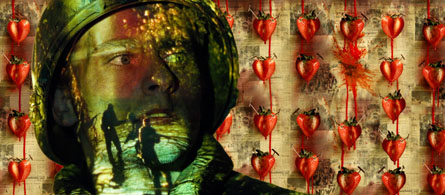
Across the Universe*
Julie Taymor takes the music of the Beatles and creates what I consider to be a very “real” movie about the angst and stress and greatness of the 1960’s and 1970’s Vietnam War period. It’s a MUSICAL. It’s the Beatles. But still, if you were between (I imagine) 15 and 35 in the 1960’s or early seventies, this film gets it. If you weren’t there, it’s still great. For kids, for teens for adults watching now. Yeah: in fact this film would indeed make a Top 50 list if I made it.
The King of Masks (Wu Tianming)
For children of all ages.
Chunyhang (Kwon-taek Im)
Based on one of the seven extant long-songs sung by p’ansori masters in Korea. Magnificent.
Moulin Rouge* (Baz Luhrmann)
You know, La La Land is very enjoyable. But it just doesn’t compare very favorably to this tour-de-force from 2001. Does it?
Sopyeonje (Kwon-taek Im)
Looking for “the story of the blues”? Hey, here it is. Yes, overly dramatic perhaps, and we must note if it isn’t obvious from the title. It’s the blues as felt in Korea. But, wow! This is an amazing film.
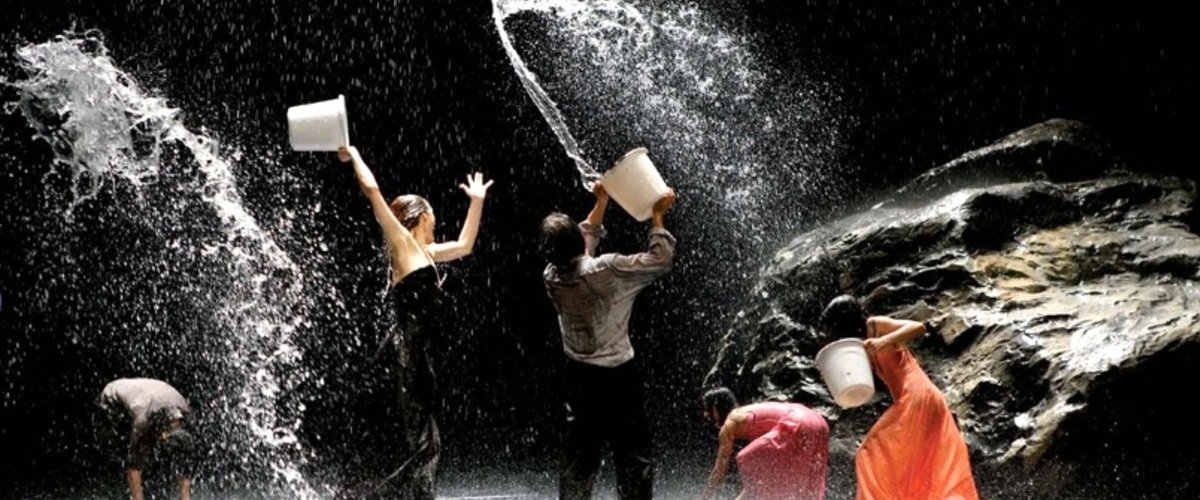
Pina (Wim Wenders)
It’s best to see (by far) in 3D, but still great in normal form. An ode to choreographer Pina Bausch.
Luck (produced by and starring Dustin Hoffman)
This began as an ongoing series on cable TV that might have lasted for years if the acting, storyline and cinematography were deciding things; but, for very good reasons having nothing to do with the quality of the show, it was cancelled during the first season, and wrapped after 9 episodes. It thus really becomes in essence a 9-hour film, a brilliant piece of fiction about various characters surrounding a race track in Los Angeles. I bring it in here because the music is used in such an extraordinary way to tie the stories together. It’s a beautiful job by the composer and editors. Created by David Milch, who also brought us Deadwood.
Tremé (by the creator of The Wire)
Four seasons focusing on New Orleans, post-Katrina, with the major focus being on the culture/music of the city. There’s just a ton of great music here, although the free-jazz scene in New Orleans is not featured! Kidd Jordan, the octogenarian free-jazz saxophonist does get one walk-on towards the very end of the series, but unlike almost every other real musicians who is shown during this fictional series, he only gets to shake the hands of the characters, he doesn’t get to play. Still terrific.
I Am Cuba* (Mikhail Kalatozov)
Just remarkable on DVD as well. If you don’t know this director’s work, then dive in to all that’s available.
An American in Paris (Music by George Gershwin, choreographed by Gene Kelly)
And it won a lot of Academy Awards!
The Good, the Bad, and the Ugly* + The Big Gundown (both directed by Sergio Leone with music by Ennio Morricone)
Mulholland Drive (David Lynch)
Moonrise Kingdom (Wes Anderson)
The Fantastic Planet
Animation of the highest form
Naked Lunch (David Cronenberg)
One of my favorite films to watch on DVD because every scene is intense, packed with details. Breaks between scenes are necessary so as not to miss more details. In other words, multiple viewings reveal more and more. Top 50 likely.
Timbuktu (Abderrahmane Sissako) - 2014
Music a critical element to the story. Make sure to check out the interview with the director in the extras.
Dancer In the Dark (Lars Von Trier)
Bjork stars in all ways, but the film is great in all ways as well.
*Best if seen on a big screen first. (But wait a minute; isn’t that true of any film. I would say yes. But Naked Lunch really nailed me on the small screen, for example.
I’m going to leave it there. Please send us your thoughts on other films you can watch over and over (probably). I just took 2001 A Space Odyssey* off the list. The music is dominant – important – in this film, for sure, but no one could watch this over and over except its director. (But it is a great one if you’ve never seen it.)
January 2017 Favorite Street: Larry Ochs
Cave Ruminations
Prologue: In spring 2014, I received an email from one Alban Jacques in Toulouse, France. He had recently explored a “privately owned cave” near Toulouse at the invitation of the owner, a cave that held some 150 prehistoric man-made cave paintings. Would I be interested to record in the cave with saxophones and see what happens? Two and a half years later – Gerald Cleaver, Larry Ochs and an official exploration crew - organized by Alban Jacques and Rogue Art CD producer Michel Dorbon -wended our way down into this wild cave. My experience was unforgettable. What follows is an attempt to describe it. The music that came out of the experience will become public later.
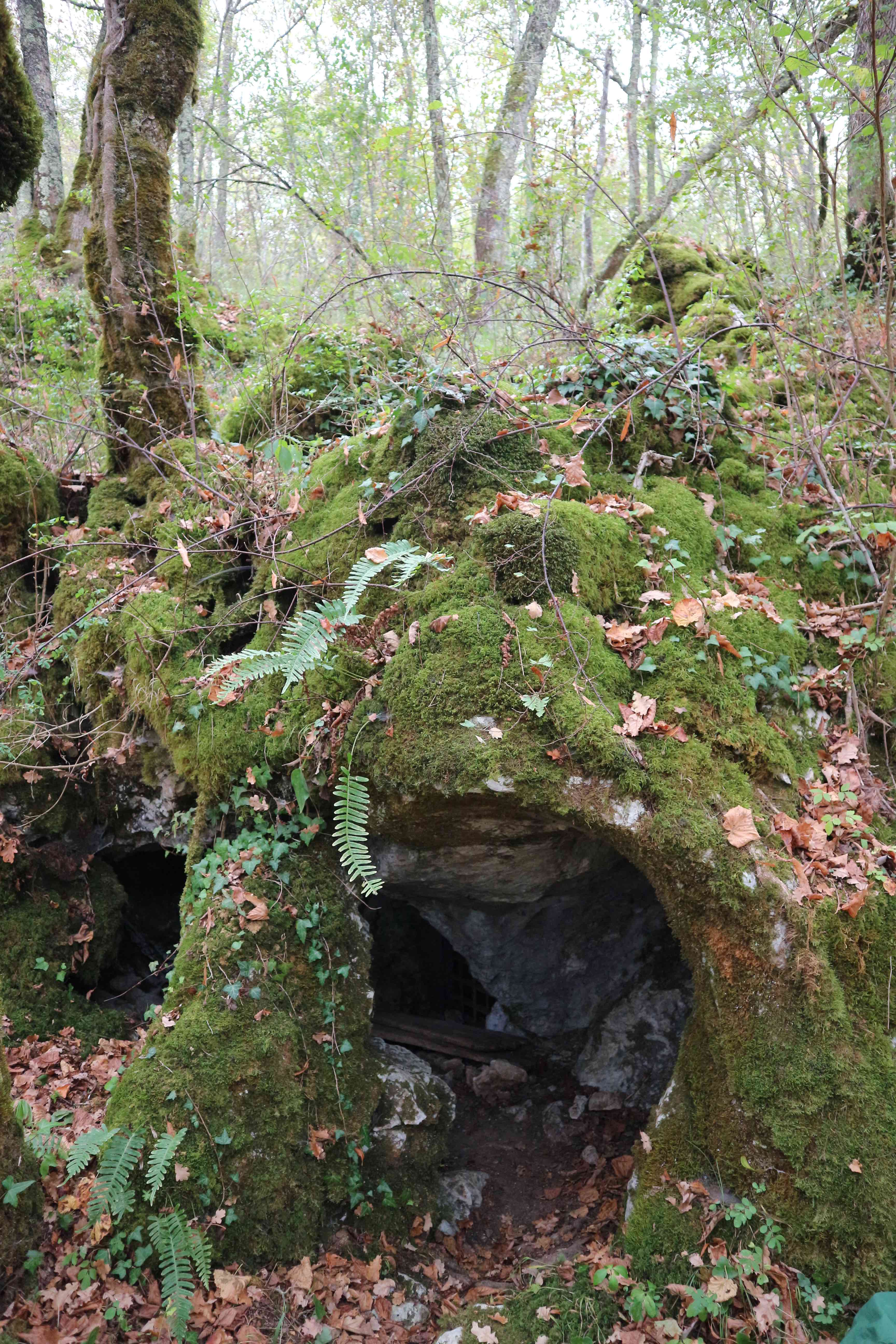
It was only upon my return to California, and the subsequent receiving of the live recordings from our just-completed journey to the secret cave, that I was able to stop feeling tragically about this adventure. I thought I had blown the entire mission; that I’d missed “grokking” the cave; missed taking the time to “get with the vibe” of this wild place; set my priorities all wrong and failed to connect with the cave’s untrammeled natural environment. But when I heard the first minute of the raw recording I realized immediately and happily that “the cave was there with us the whole time”; it made us a part of it immediately. This wild place had in fact been the third participant—and the main participant—in a three-way music-improvisation that also included Gerald Cleaver on his partial drum-kit, and myself on saxophones.
My wife Lyn made the comment a week or so ago that it’s only after the fact upon reflection that she begins to understand extraordinary events. I didn’t go into this trip thinking about any of this because as usual I didn’t have time to pause and reflect on what was coming. In my world, it’s almost always about managing the day in front of you and being present for the immediate event. Sure; there is a planning stage where one usually lists the events in order and gets mentally ready to go down that list and nail each situation in its expected order. But, this project was different aka unique. So different that there was no anticipating much of it. I had been in caves before. But never in a truly wild cave where few humans per year are even allowed to enter. So even if I’d taken that time to mentally prepare, even if I’d looked more closely at the list of activities and tried to imagine them, I didn’t have the experience to anticipate them. I still regret (as I write this) not having another day there. Just one. But then, that’s after the revelation of the recordings. If that third day in the cave had been scheduled / allowed by the cave’s owners, would we have actually listened to the recordings from Day 2 before going back? Would we have actually taken advantage of that extra day “to go deeper?”
New York based drummer Gerald Cleaver and I had arrived in Paris on separate planes on September 28. On the 29th we performed our first duo concert in 3 years at a fantastic privately-owned art gallery on the outskirts of Paris. We were thinking of it as a warm-up for the cave concerts to come. As the music went by, it was startling; improvised music is a wonderful and unsolvable mystery, at least to me. Where is this music coming from? What’s being tapped into between these 2 players (or however many players are involved) that makes this set unique and more importantly, particular to the specific musicians involved as well as to the specific vibe in the specific room full of listeners? Why is it that, if we added another skilled practitioner of improvised music, that the entire character of the music might radically change? So after the set was over, while I felt good about it, I did wonder about how playing together in a cave would effect our music.
On September 30 we flew to Toulouse with producer and confederate Michel Dorbon, who was very involved with us in planning this journey to a cave near Toulouse. We met the instigator of this adventure, Alban Jacques, at Toulouse airport. Alban had read something that I said in an interview about how I loved the challenge of playing music in unusual environments, and had subsequently, in spring of 2014, invited me to record solo in an unnamed wild cave near to Toulouse. I love crazy ideas like this; but I did immediately request a change in the idea; namely: that I had to have a percussionist with me. And then there was the reality of finding the funds to do this. That process took the next 2 years to figure out.
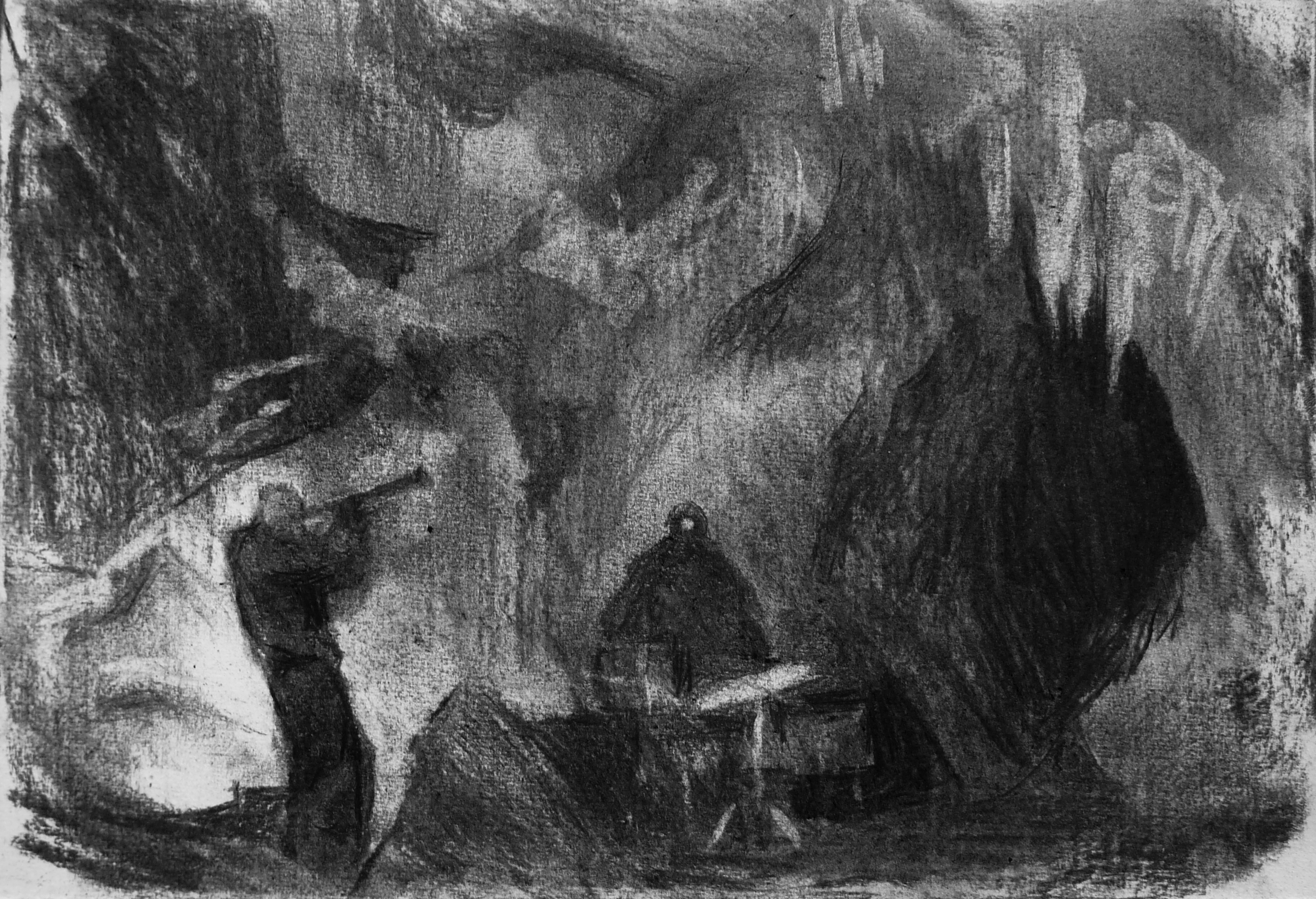
Day 1 at ‘secret cave’ was super, and super-intense. There was a distinct sense of losing one's bearings down there. A veritable "fish out of water" situation. There were distinct issues leading to a sense of complete disorientation, however it wasn't totally obvious that this disorientation was happening while we were down in the hole. It’s hard to explain, but let’s say that it wasn’t like we were going to the moon. If you’re going to the moon, then I imagine you “know” that you will be disoriented and that all your senses will need time to adjust. But we were still on earth, and we were still on land, and I had been in caves before. So when we went underground here and became disoriented, my mind didn’t adjust. Issues: 1. the total darkness everywhere except where one’s own or a confederate’s directional headlamp was pointing / and 2. the general sense that the floors beneath you were completely unstable more than half the time aka loose rocks of a size that made it impossible to stand on them even as you couldn't avoid stepping on them (too numerous to avoid). So one had to point his headlamp down to see the rocks below while at the same time needing to see the often narrowing walls or the lowering ceilings of the way ahead. 3. Then there was the slipperiness of the descents...not all descents but most of them seemed to be somewhat wet, so that the walls' clay-composition was a bit wet or the calcite(?) was smooth while footholds were too infrequent. Both Cleaver and I had the distinct impression that a slip could lead to a serious face-plant into the rock wall—on descents always right in front of your face—with a simultaneously out-of-control slide down the wall, with your chin and nose hitting off rocks all the way down.
Nice image.
Once we were essentially in there, we still had to deal with similar sensations. Balance seemed to be an ever-present issue. In the first of three proposed chambers or halls we looked at as possible recording rooms, the floor was absurdly unstable. It eliminated the room completely from consideration, even though the acoustics of this first larger space were the best of all the rooms. The sopranino sax, which I hauled in for this purpose, had a beautiful sound in chamber 1. (At times I could not fit down the “hole” and also carry the sopranino, which is extraordinary because the sopranino case is relatively small, but still, it made negotiating the descent too difficult, so we would pass the case down from one person to another.) But not only was the floor unstable, but at the other end of this first chamber from where we entered, maybe 15 to 20 feet across from where I stood (?- pretty hard to gauge distance down there...), there was also like a 10-foot drop into an equally large chamber that essentially opened out from the first, and acted like a reverb room would in a studio, except that there was nothing artificial about the reverb in this cave. Happily the reverb was also perfect, rather than overwhelming with a long, long time delay; instead it was very rich and with a very slight time-delay on it. So it made the horn sound great. Anyway, that drop into space from chamber 1 into its “reverb room”, combined with that floor's size and instability kind of made all of us want to flee. In fact everyone else split quickly, but I stayed around to check the sound. (I see now that Gerald was there videoing me on sopranino and checking out the sound.)
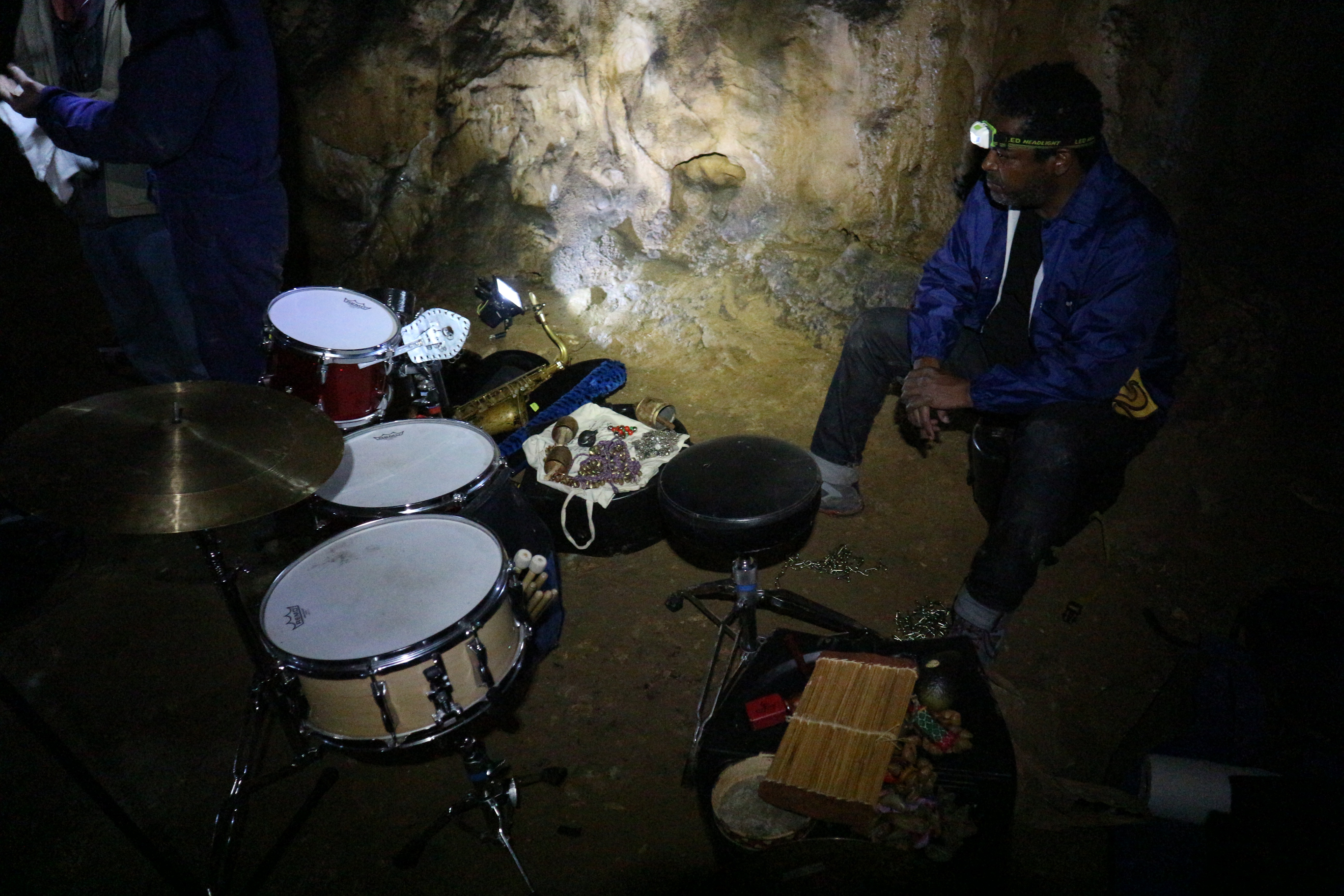
The next potential recording chamber we hit was a lot bigger, but best of all the floor was a sticky-feeling clay, and most all the rocks were embedded in that clay. Thus more stability. This chamber also had a few places to sit that were either dry or big enough to feel comfortable, or both, and stable. The sound was not quite as rich as in chamber 1, but an adjoining large room or two made the sound seem excellent, and again no major or exaggerated echo/reverb.
We did see quite a few of the Paleolithic cave paintings that first day. The ceilings in rooms 2 and 3 were probably about 9 to 15 feet above us - but that's another guess, looking back. For sure it might have been higher as many of the paintings were above our reach and sometimes even made on an inner wall behind a second or faux wall. These essentially hidden paintings could be looked at with headlamps thru natural spaces / openings between the two walls. There was an especially cool set of deer antlers behind one of these inner walls. Never thought to ask which was there first, the painting or the front / inner wall.
A human stick-figure painting was said by our guide to be the oldest such prehistoric painting known in the world, about 24 thousand years old. A “classic” large bison was visible on a real wall leading to room 2. A classic horse painting on another… And even if there had been time to make these notes just after being in the space I don't think I would remember much more, or could be more certain of room dimensions. Would have loved to have been able to write impressions before re-entering on Day 2 because right at that moment I would have been hip to what I was missing or not understanding. And then I might have been sure to note these imprecise recollections and look to get more precise on Day 2. So it goes.
We actually were only down inside for maybe 3 hours on Day 1 because we were delayed in getting in there by 90 minutes, and then as we approached 8 PM, our Toulouse producer wanted to start the ascent and exit in time to eat at a reasonable time for his wife, waiting at his home to feed us. (But we only arrived after 10 Pm anyway. And please note: our host-organizer prepared the meal during the day; his wife heated it up just before we arrived...). But we were beat. The ascent was easier than the entry, but the parts involving scaling walls using only a rope to hold you was again "exciting" and a bit stressful...the ascents were rarely 90 degrees. More like 45 to 60 degrees, but again, there was little foothold / traction on the fairly smooth rock walls, and thus the need for ropes to pull ourselves up with, usually attached around very wide stalagmites protruding from the rock walls. When we finally reached the top and crawled thru the hillside hole called "doorway" and back into our world, it was quite a feeling. We had entered late afternoon and came out in the dark, and as we crawled thru the doorway, both the temperature, and the humidity and air quality changed dramatically. Plus although dark, there was more natural light outside than we had had for 3 or 4 hours… This was a stunning moment, in that your senses realized maybe for the first time that they had been feeling tentative, like a fish out of water, for the last few hours.
Day 2 at the secret cave
First thing to say is that everything about the entry back into the cave was for me a lot easier on Day 2. Distances down seemed shorter; footholds seemed easier to find; the detour to chamber 1 didn't happen again, leading to a much shorter trip into the recording space aka chamber 2. Cleaver in fact thought that we had only just entered chamber 1 and wondered aloud why the engineer had set up in room 1. He then was sure that they were kidding him after the engineer answered that in fact he and I were in room 2. So partly we were better acclimated. But we were definitely not completely acclimated; more on that later.
The original plan for day 2 had included a further tour of more distant cave paintings found beyond chamber 3...for the 2 artists prior to recording. To feel the vibe of the place more completely. But we were delayed a bit in getting into the cave, and felt an urgent need to hit (to make music happen) as soon as we got into that chamber where all the recording gear was set up. I was ready before that. Even upstairs in daylight. And I didn't want to expend the best energy of the day on a lot of caving; too risky. I immediately suggested to the cave owner (and cave guide) that we would be happy to see more after the recording. I wasn't sure that would be true, but I wanted him to be happy, or anyway not insulted... I figured there was no way he would be into the actual music. Very nice gentleman by the way. But there is our reality: that most people, whenever first exposed to improvised music, haven't a clue. And here we were in a Cave... hardly a place where improvised music has much of a foothold. (Of course, now that I think of it, almost everyone in this party of 10 or 11, other than the cave owner, were only there because of their appreciation of improvised music.)
So we went at it. Despite this being the best room, everything was a serious challenge. Where I was to get my horns out of their cases in fact consisted of a relatively level area. Hardly level, and hardly smooth or flat, but better than other spots. My spot was to the right of the “drums area.” The microphones were placed to right and left a foot or more away, most of the time. (The engineer actually moved them between takes.) But then there was a set of mics on the other side of the room, close to the natural reverb room. The engineer’s assistant Morgan also moved a Zoom around, sometimes locating that all the way in to chamber 3, sometimes close in on the drums. Anyway, the wall just behind me was what I would have laid the tenor case up against, but that wall was visibly wet. So I pulled the case more in to the room at maybe 9 inches from wall, where on sticky clay and some rocks.. Yes: the tenor lay in the case when not in use. My sax stands were back at the hotel as there was simply no trusting them not to tilt over on the rocky floor.
I also had to negotiate how I stood on the floor. Chamber 2 was much better than chamber 1, but my feet and legs were not all that impressed. Although I did have about an area of 3x 4 feet to move within, there were really only two positions that I could place my feet and feel stable. And those positions did feel very good during the 2 hours I stood up. I play standing up always, which was a good thing. No place to sit here.
As a result there was just not much possibility to change instruments during a piece. Had to be too careful bending down to place horn on case etc. Changed instruments only one time other than between pieces...
What else? The air in this chamber was extraordinary. The best I have ever experienced. Completely fresh but also cool and at the same time humid or clearly having a perfect amount of water in it. (Always 55 degrees in the cave. And no breeze at all, no sense of current.) I don't know how to describe the feeling. But by the end of the second improvisational piece I noticed that my nasal passages felt completely open and clean. They never ever feel that way.
Cleaver had…gee, I realize now that I didn't get a good photo of his set up. There were two drums—snare and 12 inch tom. Then there’s the 10-inch drum, normally attached to this set’s kick drum; but, neither the kick-drum, nor the larger tom, would fit down the hole from the outside, or anyway at some point were not passable into the recording chamber. So 10-inch tom had been ingeniously attached to a mere cymbal stand. There was one cymbal on another stand. He placed a larger cymbal on his drum seat for one piece—I remember that. He had various bells and small percussion. And remember: the floor was not level, so each piece of the set was at its own unique angle to the floor! Wow, and still, he made some great music.
Probably really got started about 3:45 and ran out of gas around 5:15. Just an extraordinary amount of energy involved, given that I’d gotten very little good sleep since arriving in Paris two days earlier. Focus was really good though...all improvised. Standing the whole time, even in breaks between pieces. By the second to last piece, parts of my right arm were cramping, and in a strange way that I chose to ignore, I felt this deep throbbing of the upper arm. Bizarre. Every so, often I would while playing look upwards and see in someone’s headlamp the ceiling of the cave. Exhilarating! What else? The silence in the cave was profound. (According to one of the artists making drawings of the event, it was the silence with the pieces, or at the end of them that just really moved her, and I was very thankful for this observation later on, when I was back outside the cave.) As a result of this feeling of the silence—almost physical in nature—I remember being a bit surprised at the two high-energy pieces we recorded. I had the thought during one of them that this sound-area didn't seem appropriate to the space. But definitely was open to rolling with where the music flowed to, rather than trying to force a pre-conceived concept in. I did in fact spontaneously think of an idea to put into the music twice. Those totally failed.
I went thru what I had considered three good reeds in the 2 hours, and we only got about 55 minutes of recorded sound. If we had not had a time limit I would have taken a break at 5:15 and gone for more, but as the set-up of all the equipment, including “load-in” (funny to think of that term down in the cave) had taken 2 hours, we were informed at 5 that we had to quit in 30 minutes. Bad news to get without warning.
But the 8 witnesses were absolutely blown away by the music, so I hope that translates to the recorded medium. Getting high on the oxygen in the room might have been a big part of their reaction, or perhaps just being down there as this spontaneous reaction to the cavern took place. We shall see what the mixes tell us.
Luckily the engineer was not only way into this concept, but he seemed to be a brilliant guy. Being the tallest of the group by a good 3 inches and without a hard hat, he was also the one person to literally crack his skull on the ceilings more than a couple of times. Was bleeding rather dramatically in fact when he appeared outside for the picnic on Day 2. (The musicians waited “upstairs” for a couple of hours while everyone else prepared for the recording; I am still amazed even now at the energy all 8 of the other witnesses brought in order to make this happen. It’s not something I am at all used to being the beneficiary of. So I appreciate it that much more.)
And what a great repast prior to the recording. Mr. Alban Jacques did a great job at all levels of the organizing.
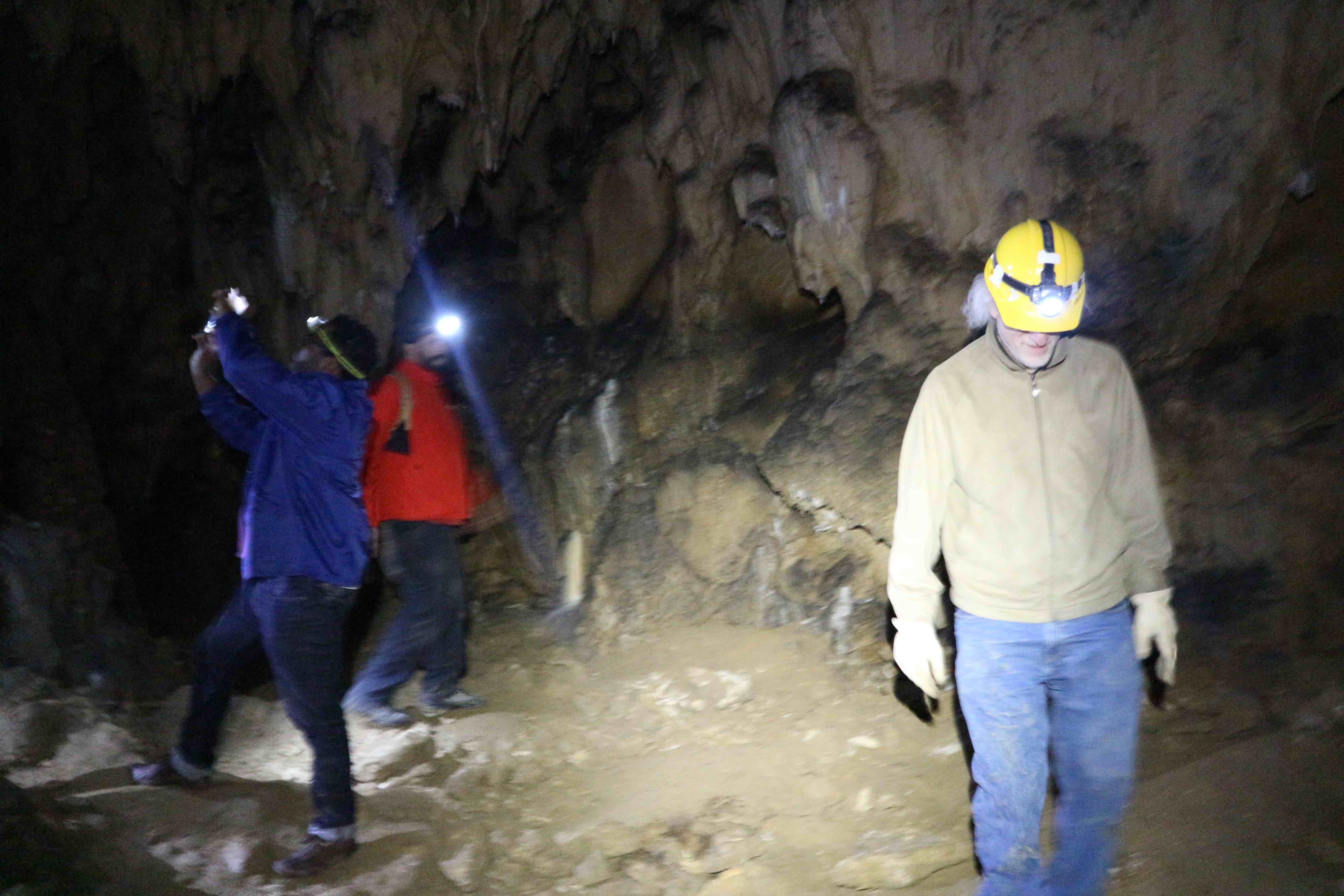
The artists' drawings in the cave captured the feeling in the chamber better than any one photo I saw could capture it. Especially the artist drawing in charcoals seemed to get the feeling of being down in that cave for me. (Note: as of this rewrite I have seen many more photos and there are quite a few great ones.)
I am sad not to have had time to be in the cave for an hour or two without responsibility prior to the recording. I feel like that experience might have led to a profounder music. I have this grief, even, that a unique opportunity (literally unique; the owner said he could never risk this incursion into the cave’s atmosphere again; the thing is that the Paleolithic paintings might be degraded by the change in the air quality what with so much human breath and assorted activity taking place) just got away from me on that level. But having noted the regret only in hindsight, I can't honestly see how we would have known to rethink the sequence of in-cave events before the fact of the 2 days, as it spooled out. While my feeling of regret, or even loss, hit me almost as soon as I re-entered planet earth’s atmosphere on Day 2 about 7 PM, while I was sure that I had not connected with the cave ambience fully, It was only in the days following, when certain aspects of the experience became clear to me thru brief conversations with the witnesses on the trip, that I felt certain I had, after all, not immersed completely into the cave’s world. But then, it’s very possible that immersion was impossible, or that there was nothing to immerse into. Still, it went by way too fast. Couldn’t keep up with the speed of events and in addition perform the music, recover from that, and also be open to receive the input of the cave art.
I did try to experience “pitch black darkness” by going into chamber 3 after the recording and turning off my headlamp while no one else was in there. But part of true total blackout would include total silence, and that wasn't happening at that moment as the packing in chamber 2 could be faintly heard. Nevertheless, the darkness was pitch black. But, having just recently recorded and packed, having just expended a full supply of energy towards the goal of nailing the recording, I couldn’t get centered on the darkness, or couldn’t get “into it” and beyond.
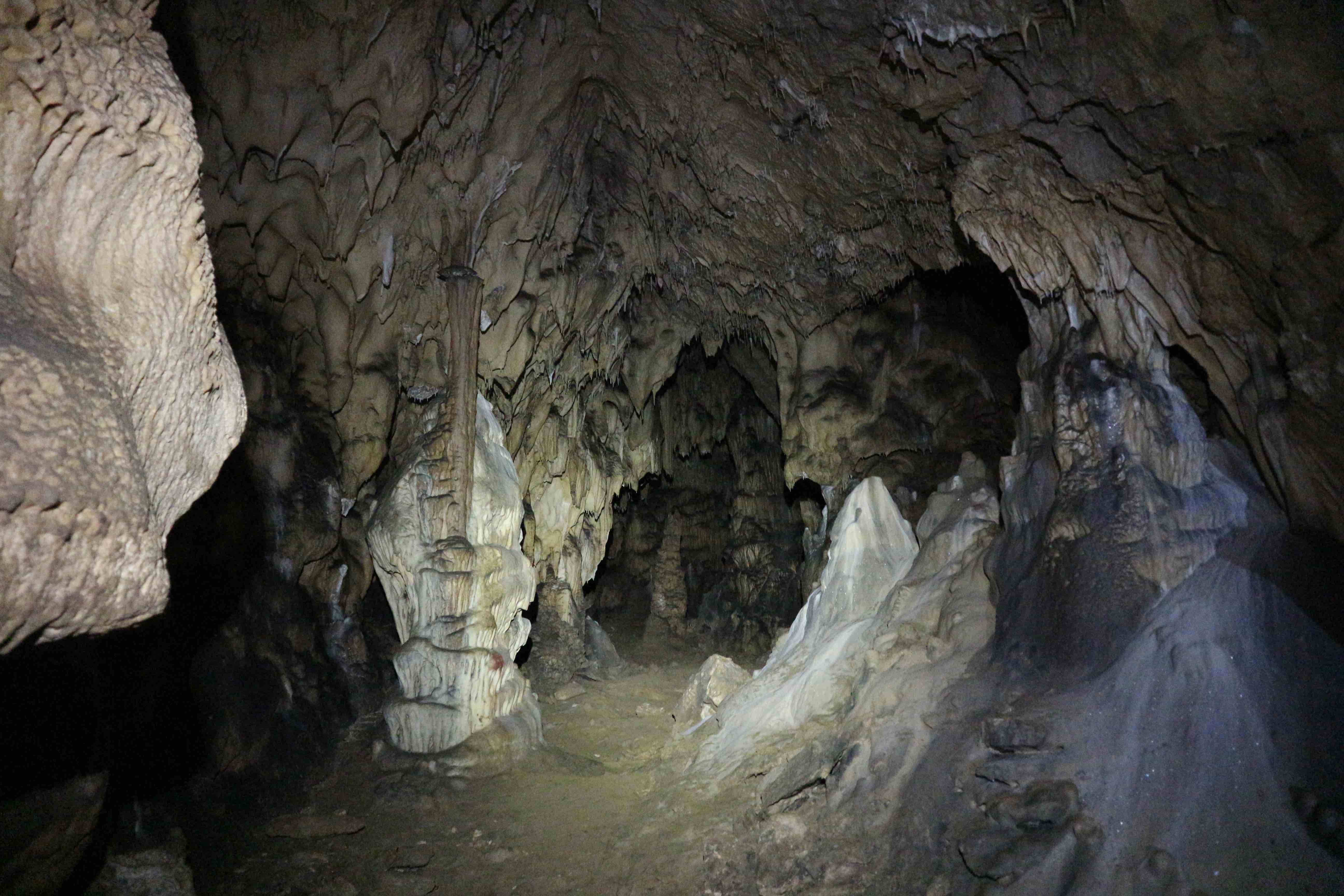
But then the recordings arrived as a download here. I had impressions of them of course. But as I tentatively dug in to the first track, I was overwhelmed to discover that the reverb of the cavern I had heard was or seemed to be more than merely a room acoustic in the recording. In fact, the cavern space felt like it was a full partner, if not the main partner, in the improvisation. Rather than a duo, it was Cleaver and I negotiating our way into a trio with the space. But not just with the reverb of the space. As I said earlier, in a large church such as Grace Cathedral, the physical acoustics of the room completely dominate the improvised interactions; you can’t ignore it. In fact, you must frame everything to fit in to the church’s “sound.” The church rules.
In the cave, the cave didn’t rule. It allowed us to take all kinds of improvised angles; it was rather an equal partner, and a generous one at that since, at least speaking for myself, the cave made everything easier, and I felt like everything sounded good, physically speaking, at least until the final piece we created (which as of my 3rd listening now turns out to be a beautiful piece after all…) …What a relief! There will be some documentation from this adventure. I can feel now like we did it. I think all of us would now like another crack at this. As if we met someone really special and wanted another meeting, ASAP! But at least we had a nice hit that first time. All was not lost even as “we” typically (in this day-to-day life in 21st century) tried to squeeze too much into too short a time-period.
When the first mix arrived here from France, it took me a few days to be willing to listen at all, and then I could only take in one track a day for the first 3 days. So much emotional investment involved; you dig? But, as I conclude my listenings now, I’m excited about the music we got. Just hoping others will hear the Cave as a co-equal in these musical creations. For sure, Gerald and I went to a number of musical places that we haven’t inhabited before or since that day in the secret cave.
And massive thanks to Michel Dorbon, as well, for helping big-time to make all of this possible. Funding the recording side, coming on the adventure with us, hauling materials into the cave in his form-fitting jump-suit. Very cool character straight out of a classic French arts scene.
September 2016 Favorite Street: Larry Ochs
Who are US - Thollem McDonas and Angela C Villa
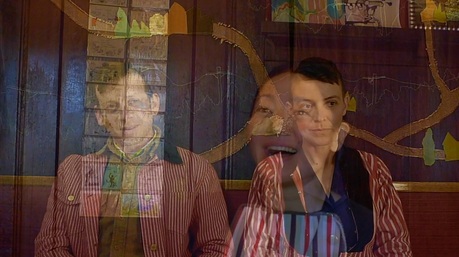
CHECK IT OUT!
SUPPORT THE ART of living, breathing creative artists. Villa creates all the images and folks – is a great editor. Yeah, turn off the sound if you want to, and just dig the montage alone. Riveting.
But I don’t recommend experiencing this in silence; Thollem kills the sound side of things here. The two of them are travelling all of 2016 throughout North America. And as Thollem performs everywhere, sometimes solo and sometimes in collaboration with locals, Villa shoots lots of travel images and close-ups of people and places. I can’t describe it. MORE THAN THE SUM OF ITS PARTS. Brilliant. I pretty much guarantee this will be noticed by the critics when the time comes for that. But you can check it out now and help them to keep it going.
Braxton plays Coltrane’s Impressions
(video on YouTube)
This footage is from 1981 Woodstock Jazz Festival, commemorating 10th anniversary of the founding of the Creative Music Studio in Woodstock, NY. Featuring Chick Corea, Miroslav Vitous, and Jack DeJohnette.
Long on Logic - Rova Saxophone Quartet
1991 - Sound Aspects (Germany) SAS 037 (CD)
Recorded at Different Fur Recording, San Francisco, CA, March 5-6, 1989 (#1-4); at Bay Studios, Berkeley, CA, January 25-26, 1990 (#5-8) by Robert Shumaker.
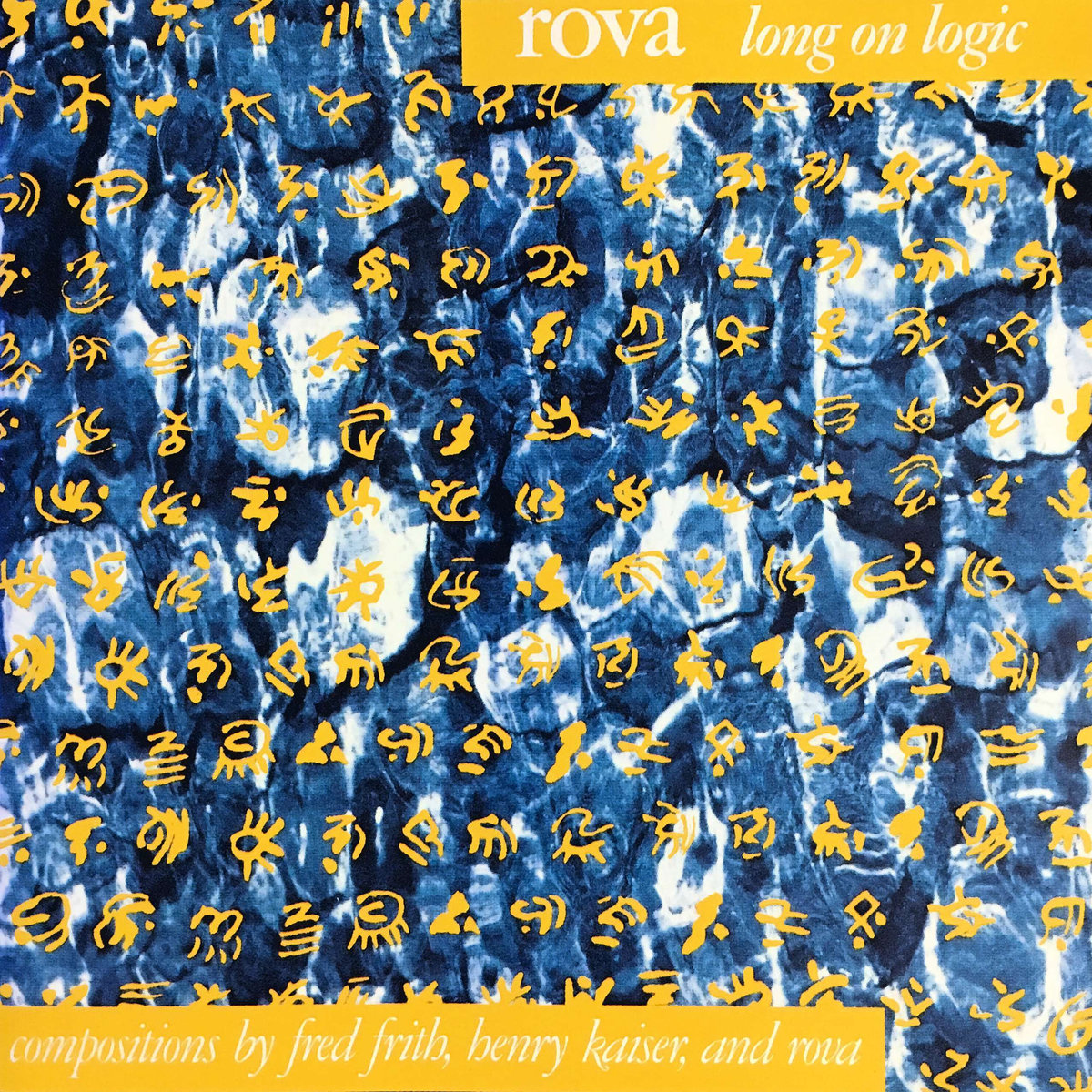
Raskin and I have been talking about for years about making certain CDs long out-of-print available again. Finally, we got some valuable help from outside the band and loaded up a page at Bandcamp with current releases and some rare CDs you can’t find anywhere else. The highlight for me of this first batch is a CD that Rova put together in the early 1990’s: a quartet CD, and the first one released with Steve Adams. It features compositions by Fred Frith and Henry Kaiser as well as Rova pieces. After it was mounted, I clicked on the piece “Long on Logic” just to see that everything was working correctly. But – I liked what I heard so much that I listened to the entire 10-minute piece. And then I wrote Frith via email and enthusiastically raved about this piece, which I hadn’t heard in decades. Beautiful. Wrote it down on my Favorite Street list immediately.
Check it out here on our Bandcamp page
Senegal 70 (CD)
This music comes from a period of “African fusion” that I’m very partial to. And this is a compilation of unreleased music from a very strong period in the history of that locally recorded music. Includes pieces by bands you’ve heard of if you’re in to this already, and lots of others. A great introduction too. The enclosed booklet in the actual CD is thick; full of priceless information on the history of Senegal’s music, the reasons it flourished, and info on all the bands. Thus purchasing the physical CD really matters in this case.
Stanley Kubrick: The Exhibition
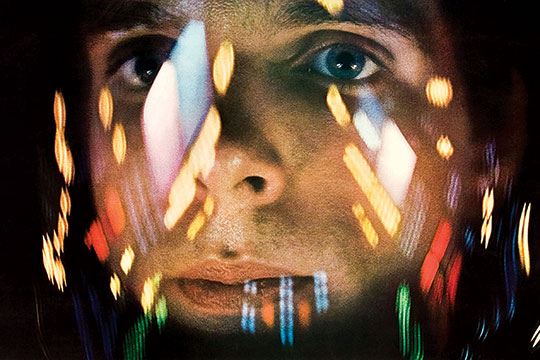
This is a film fan’s dream exhibit. The show spans Kubrick’s entire career including a sampling of his photographs shot for Look Magazine, often influenced by Weegee, and his first two films: 10-minute documentary films, both of which are shown in complete form on video machines mounted on a wall. The cool thing is that most all of his completed films each have their own wall of information, stills, and samples of the films to be viewed with headphones giving the synchronized sound. There’s a lot more going on too, including a room at the end of the exhibit that holds a library full of work, etc. from his unfinished films. I was there for two hours and need to get back before the show closes.
Contemporary Jewish Museum
736 Mission Street (between 3rd and 4th Streets)
San Francisco
On DVD and Blu-ray:
Where to Invade Next
Director, Michael Moore
Moore has a vision and he sticks to it. He’s devoted to something that can act as a lesson or sometimes even a model of how to improve the quality of life on earth. WHERE TO INVADE NEXT is funny, it is smart, and it really makes its point over and over in ways that resonate. The picture is ultimately touching even though you laugh a lot on the way thru.
Embrace the Serpent
Director, Ciro Guerra

This film immediately entered my top 100 films of all time upon seeing it. I went back 3 months later—it was presented at a Berkeley multiplex for almost a full year—and I think it was better the second time. Shot in a glorious black and white in the Amazonia region of Colombia; incredible acting by some pros, but also a large group of one-time-only actors recruited from the depths of the local area. I have no idea how this will play on video, but I sent a copy to a friend of mine in NY, and he loved it on DVD. Some of the shots of the river and the transitional shots between the two eras that the movie takes place in are so incredible on the big screen. But I think you will love it on the small screen too. The lead character, played by 2 different actors in old age and in the character’s powerful early adulthood are mesmerizing. Recommend this on Blu-ray if you have that technology.
Brute Force
A taut, searing black and white 1947 film starring Burt Lancaster. Classic dialogue, classic noir lighting in this film about an attempted jail break from an American prison. Influenced a lot of great French directors of the fifties and sixties. See this and The Naked City and White Heat, all made in the late 40’s when despair was hot in Hollywood.
Directed by John Ford
Director, Peter Bogdanovich
Yeah, I actually was tearing up in the last 12 minutes of this super-informative documentary when Bogdanovich, after making the case for Ford as the greatest American director, ended the film by presenting three of his favorite endings to Ford films. Of course The Searchers was one of these, but How Green Was My Valley—beautiful. Didn’t remember that ending (mainly because I found it hard to get to the end of that film; little too schmaltzy leading up to that.) Anyway, scene after scene as focused on in this film are analyzed by several talking heads in concise and revealing ways. In other words, whether or not you know Ford’s films, this documentary is right up there with other great films about film-making, and I heartily recommend it for the knowledge it imparts while also introducing you to so many highlights of Ford’s work. Not to mention some hilarious stories told by actors who worked often with him such as John Wayne, Henry Fonda, and James Stewart. Not to mention the incisive narration of the film by another great director named Orson Welles. Made in 1971.
March 2016 Favorite Street: NYC Residency, pt. 1 – Ochs Reports
For an artist or an ensemble to have the invaluable opportunity to perform nightly for several days is so rare in our decimated music scene. And to be able to have a string of gigs without having to travel allows all focus and energy to be on the art and performance, rather than the logistics and drain of moving from city to city, hotel to hotel. Rova’s east coast residency from January 17 to 24 will certainly serve as a watershed in our nearly 4 decade history: the year-long prep and the run of spectacular concerts has given the band an even deeper connection with our music and its possibilities, and opened windows to the next period.
The shows began with an ecstatic Electric Ascension on January 17 at Le Poisson Rouge in the West Village, and continued for the following week at the Stone on the Lower East Side. We were honored to have been invited by Winter Jazzfest and John Zorn to present a week’s worth of our music, both past and present; music presented not only as a quartet but also in several larger ensembles, chosen from the many special projects created over the past 38 years.
Below Rovas Ochs and Ackley offer reflections and insights garnered from this exciting trip.
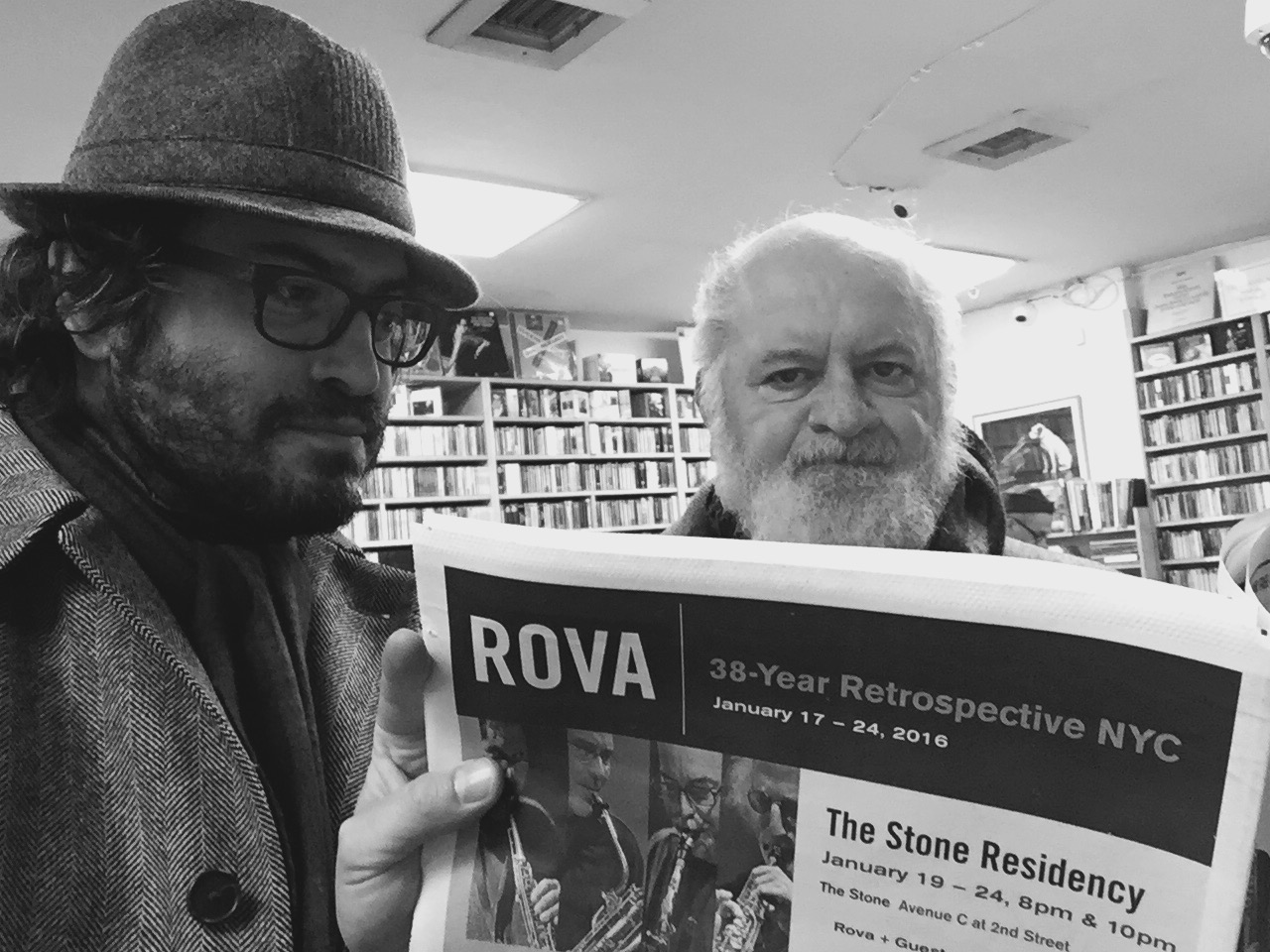
Italian jazz lovers getting the news in New York, January 2016
Electric Ascension New York – January 17, 2016 – Ochs Reports
So much goes into getting one of these shows “ready.” That’s the way it always feels before it happens. First there’s corralling the right combination of musicians, given whatever limitations are imposed on any given show. For example, because this was taking place in mid-January when weather can be a factor, I felt absolutely that all the musicians had to live in greater New York City. For example, we knew going in that 12 musicians would only have 6 monitors, and we knew going in that Electric Ascension had never really worked all that well in smaller venues like the club space we would be taking it in to in New York. A piece that is often about collective sound-mass, about expressive sounds en masse, is dependent on the PA system and the hall itself to help make it work acoustically.
But - after a lot of thought and discussion with our crack sound engineer Marc Urselli and the club’s tech staff, and after the performance-day’s sound-check and walk-thru of the piece, when the concert started - if not “right from the downbeat” then certainly by the 12-minute mark, when Nels Cline dug into “his section” and started to build one of his solos to the stratosphere - my doubts washed away, and I wondered once again, even as I found myself marveling at the music I was hearing, why I ever allowed stress to creep in. Coltrane’s composition, rendered fifty years ago in 1965, pretty much guarantees that the bandstand is going to lift off during the performance, usually more than a few times, as long as we have a great crew of musicians that feels it and steers it and an audience ready to roll with us.
The New York show slammed into gear right from the downbeat. Ochs started right in with the first line of the theme, and right behind him, it seemed, came a drum shot from Gerald Cleaver that announced to the audience: this ride is on! Very cool.
Back to a few of the many highlights of this night’s rendition in a minute; a little more back-story: Rova was invited by John Zorn over a year ago to come to New York January 17-24, 2016 and create a retrospective of sorts; 12 concerts at The Stone in 6 nights highlighting Rova’s music; which we interpreted as highlighting both the quartet repertoire and as many collaborations as we wanted to recreate. This sounded great to me, and when I presented Zorn’s offer to the other Rovas, they jumped at the idea. It was easy for us to imagine doing all kinds of things that week at The Stone. But the one show I really wanted to be part of this retrospective that just made no sense at The Stone was Electric Ascension. Too many musicians to fit in a semi-circle at The Stone; the need for a really grand PA - amplification that fills a room with clean sound - and of course there’s the fact that Ascension inevitably draws a lot of people.
Ascension draws an audience for several reasons.
The name “John Coltrane” is a definite magnet. Like many bands in today’s improvised-music-world, Rova can’t count on a large audience for every concert. Art music never can count on a large audience. But whenever a Rova show has been advertised as playing Coltrane’s Ascension, the shows have been very well attended, if not sold out. That of course is helped along by the fact that our Coltrane show has been Ascension or Electric Ascension, which requires a large ensemble of between 11 and 13 players - 7 to 9 guests. When the guests are players like those we invited to play in New York, that also helps draw a crowd. And then Rova’s Electric Ascension has been played now 11 times over the past 11 years, and there have been numerous press raves; there has also been a Kickstarter campaign that created more of a stir. (It’s ironic to think that, as a teenager in 1966, when Coltrane was at his zenith in terms of notoriety in the press, that his late period music was an “art music.” I exited a Fugs concert in the East Village one night, walked around the corner and saw that it was just about time for Coltrane’s second set to start in the basement of the Village Vanguard. It was a 10 or 11 PM show on a weekend night: maybe there were 25 people there, but for sure there were way, way less than had been at The Fugs concert I just had left. The room felt empty.)
It only dawned on me in the few days before playing this 2016 show that the venue we were to play in the West Village was the same place I had seen Coltrane play in 1966 or 67 – the basement of the Village Gate, now well known as Le Poisson Rouge. Man, I wanted this one to go really well. Part of me wasn’t worried; we had done this before, and beautifully. But one can’t help wondering: will all the musicians be psyched? How will the newbies do? Is this club-space – smaller than festival halls - going to be able to handle the dynamic levels? Will the sound engineers be on top of it? A case of nerves is part of the deal—I welcome that—but in this kind of situation, the nerves are exacerbated not only by all the unknowns, but also by the expectations created by the publicity and of so many people who you know will be there. Not to mention that previous performances, although years ago now, have raised the bar way, way up.
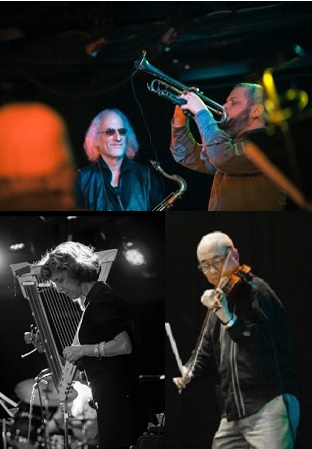
Ochs, Nate Wooley, Zeena Parkins, and Jason Kao Hwang
What always impresses me, and it did so again this time, is just how far along the world of improvised music has come in terms of “hearing” the music as you create it. You can gauge this leap by checking out the contributions of the “newbies.” It’s important to have at least 2 players on board for each show of EA who have never played the piece before. Their new contributions, it is hoped, will add an edge that wasn’t there in any of the other shows, automatically pushing all of us along into fresh sounding terrains. Steve Adams says it best in the documentary about Electric Ascension (that is part of the new Rogue Art release). One is always looking for improvisers who are “instigators;” players whose contributions to the group music are startling and stimulate everyone else to new heights. The newbies have an advantage here in that their vocabulary has never been heard in this context. And in the case of this show, I’d have to say that the three absolutely new players – Gerald Cleaver on drums, Nate Wooley on trumpet and “amplifier," and Charles Burnham on violin – all instigated at some point or two in the proceedings. Most notably for me: Cleaver’s “downbeat," a single drum hit within seconds of my playing the thematic first line of Coltrane’s head, and his ground support behind me early on; Burnham’s beautiful playing in the section he was set up to lead near the end of the performance, and Wooley’s incredible contribution half-way thru the piece on “the amplifier” - where a microphone placed inside his trumpet bell triggers amplifier sounds that are then picked up by a second microphone, hanging from the amp itself, which loops back into the amp, setting up what can best be described (by me) as a unique electric guitar imitation, but on steroids. Standing right next to Wooley on the bandstand, it was my pleasure to take this in from one foot away, also noting how much it seemed to be pushing Nels Cline, just to Wooley’s left, to find an appropriate response. A rarity indeed for Nels: an instigator getting instigated himself.
This is the beauty of Coltrane’s Ascension. It welcomes all the players in. Rova has something to do with it in that the instrumentation is ours. Equally important, the arrangement gives everyone at least one section where they can lead or co-lead and instigate, and lots of other space where they can support the lead voices or help make a collective sound more brilliant.
As always though, we were reminded again that this “modest” one-page composition is the foundation and the inspiration for all the complexities. In 1966 it pushed a whole bunch of now-iconic musicians to explore a world they had never or rarely inhabited before. There’s been 50 years of collective learning and listening since then. There have been many, many years of growth in the world of improvised music, many years of gleaning how to listen and how to be part of a collective sound. It all eventually adds up to music that overwhelms – in a good way!—the musicians taking part, who leave with smiles on their faces – and the audience lucky enough to have been in the room with us. And yet, it’s interesting to note that, when an audience member gets home and exclaims to his family or apartment-sharing friends “I just saw the most incredible music event!!”—and he is asked to describe what it was like, s/he pauses and can’t find the words. Still, even now, fifty years after the piece was recorded and 38 years after Rova first started. And there lies the beauty of this improvised music world, as well as the reason there aren’t many more fans clamoring to hear it. There lies the reason that I was able to walk into a John Coltrane concert at the Village Gate in New York in 1966/67 and have no problem getting a seat.
The Celestial Septet @ The Stone – January 20, 2016
The Stone buys into and believes in and even I think celebrates this very truth. John Zorn’s place is set up based on the understanding that serious improvised music is best heard live, and because you need as a listener to be in focus in the moment, all distractions found in most clubs are not allowed: no bar, no cash register, a simple PA and enough room for about 75 people tops, all sitting as close in to the musicians as possible. If Zorn had his way, nothing would be recorded or sold there. It would be literally a haven for musicians to evolve and for listeners to be inspired.
With friends like these: Joining Rova to make Celestial Septet NYC: Allison Miller, Trevor Dunn, Nels Cline
Rova, bassist Trevor Dunn and Nels Cline all played in Electric Ascension on Sunday at LPR. On Wednesday the six of us reconvened with added guest Allison Miller on drums. In this case, we got together to bring back to life three pieces that Rova and The Nels Cline Singers first put together in 2008, touring the pieces in 2011 as The Celestial Septet, just as a CD by this band released on the New World label. These pieces are all great fun to play—and Allison Miller, playing them for the first time as a sub for Scott Amendola, was simply remarkable in both her contributions to the music and her immediate grasp of the music’s possibilities. But the pieces, I think it’s fair to say, are coming at us musicians in a much more conventional way than Ascension does. Just like Ascension, these three pieces, taken together, include feature-sections for all the instrumentalists, and just like in our arrangement of Ascension, many different combinations of the seven players are used to help along the musical inspiration. But like most other pieces, these have ceilings beyond which you can’t take them. The structures are always fun to re-inhabit, but they are going to lead to a particular zone of exploration that’s known in advance. Can these zones be colored in ways that make them sound completely fresh? Absolutely. Can we lift the bandstand within any given section? Yes. But the transitions to the next section and the basic shape of that next section – in each of these pieces - are known in advance, crafted by the composer. This isn’t a bad thing. It’s super-comfortable actually to know where we’re headed. Knowing the character of each section in advance allows us to improvise creatively in a given section, even as we know the process with which we will transition to the next section and the sound – environment to be explored in that next section.
But Electric Ascension is different. We do have a map; we do have knowledge of who will begin play in each section. But beyond that, we really don’t “know” anything. Transitions from one section to another are conductions in real time by Raskin. And where the music goes in the next section is completely up to the inspiration in the moment of arrival. This makes it more exciting for the musicians. As for the average listener hearing the music (or more appropriately “experiencing the music”)—I think she intuits the risk being taken onstage. As a result, most listeners are super-excited as they approach the end of the performance with the musicians, not only because the players were incredible together in each moment, but because the path the music has taken has felt so spontaneous, so unpredictable. (And when Coltrane’s theme re-emerges after 50 minutes of this unpredictability, it’s always a miraculous, spine-tingling moment.) Don’t get me wrong: certain sections of this piece are really close to the same each time. But the overall path is never the same, the entity created at a given show is its own unique presence. In New York, the piece had a most unusual shape, an almost overwhelming complexity to it, and as there was no recording I can’t quite paint it for you here. But for sure it was incredibly different from the blues-drenched, almost-introspective version we hear from Guelph in 2012, on the DVD/Bluray version just released.
That’s why – even though I know going in that Electric Ascension will lift the bandstand—I’m nervous about “how it will really go.” On Wednesday night at The Stone with Celestial Septet, I instead looked forward to creating great music with other great musicians, all focused and ready to bring known compositions to life. On the Sunday before at LPR, I marveled at the fact that Electric Ascension rocked again; that Coltrane did it to me again. That 12 people who had never played as an ensemble before could walk out onstage and surprise me over and over without ever getting lost.
The entire crew-list, all in fantastic form on Electric Ascension at Le Poisson Rouge: Nels Cline (who has played in all but one of these Electric Ascension shows); Ikue Mori (who has played in “most” of the Electric Ascension shows); Zeena Parkins and Jason Kao Hwang (who each appeared with us once before at Saalfelden, Austria in 2009); Trevor Dunn (on his third EA journey); the newbies: Wooley, Burnham and Cleaver; engineer Marc Urselli (engineered also in Guelph), and perhaps the most important crew-member of us all; and Ackley, Adams, Raskin and Ochs of Rova.
(The one thing I’d like to do sometime is take you all right thru the mental side of the piece as I remember it happening in real time. But I’ll save that for chapter 2. And YES! There were more highlights!)
The Stone Residency: The Four Quartet Concerts
Of course the 38-year retrospective had to include “Rova-Quartet” concerts. But when so many of the shows at the Stone were featuring “bells and whistles” collaborations and cool collaborators, there had to be a way to try to distinguish the sax quartet sets as well. Otherwise they might appear as “the filler” gigs. Which could not be further from the truth. As much as I was excited to be playing with so many fine New York musicians that week, personally I take – I think – the most pride in the pure sax quartet repertoire because that’s what we’ve been developing over the entire 38 year span, and it’s in those Rova rehearsals that so many of the ideas we use first got thought up and explored/developed; ideas later used in “OrkestRova”, or in “The Celestial Septet”, or in the “Special Sextet’ repertoire with 2 drummers, or in quintets with Zorn, with Braxton, etc.
If we had too many collaborations to choose from for one week at The Stone, then we had an unbelievable overage of interesting sax-quartet music we could present. So we looked for categories to group the pieces in, so as to be able to pare this 38 years of quartet music down to 4 one-hour concerts (as well as to market the concerts within the Stone publicity).
Making this more difficult: only four quartet concerts. We considered doing six – one each night in the 10 PM slot. But there was the realization - number one: that except for the “Rova Now” set taken from the current book of pieces, all the other pieces would need some rehearsing on the day of their Stone presentation. And our collaborations – all of them that needed rehearsing – those rehearsals would have to take place the day of the concert; no way to rehearse them with NY musicians before that, since Rova lives cross-country. Thus, for example, our 8PM Wednesday show with Cline, Dunn and new drummer Miller, would involve a rehearsal at 2 PM. Impossible to know how long that rehearsal would take for so many reasons including: a new musician involved who hadn’t played any of the music before; 6 other musicians who had not looked at any of this music since 2011; rehearsal in Brooklyn and then show in Manhattan. Etc. As a result, we scheduled “Rova Now” for the 10 PM slot on that specific night because we know that music best. And so the deep thinking went in planning out the week.
Eventually we blocked out four sets: Older works composed by Rova members; commissions from American composers; commissions from British composers; “Rova Now” featuring all Rova-composed work in the current book.
American Composers Set @ The Stone - Set 2, Tuesday, January, 19, 2016
The American composers’ set was the toughest to re-learn and to play (overall). In the 1990’s Rova had been lucky to receive a lot of financial support that went straight to composers both inside the group and (mostly) outside the group. And we had received a ton of interesting work. Our one stipulation to all the composers we commissioned: create pieces for Rova that involve structures and/or conceptual or graphic scores for improvisers; give us compositions including notation of any kind, but also challenge us with improvisational sections based on or inspired by the composer’s concept and writing.
We eventually decided to play three long pieces by John Carter, Tim Berne, and Wadada Leo Smith, plus one very short one by John Zorn. We had also included nine minutes of Alvin Curran’s Electric Rags II – a work consisting of close to thirty 3-minute pieces. Originally designed for Rova plus Curran playing off of electronic sounds triggered by Rova’s playing, there were more than a few of these 3-minute pieces that sounded great on their own. As it turned out, however, the set was too long with a Curran suite included.
The Zorn piece Lakom is one of his Masada works; arranged by Ochs for Rova. Since we were playing as a quintet with Zorn in set one that first night at The Stone, and since his piece Rova plays was completely “other” from the 3 longer works, it made perfect sense to include it.
What drew us to these 3 other pieces were, first and foremost, that they all were seamless constructs as far as transitions from written to improvised parts and back again. Beautiful arcs. The Carter and Smith pieces were super-challenging for us when received. Berne’s piece had challenges, but it basically fit Rova like a glove, and the rewards were high when we played it. Second, the three pieces seemed like they would work well together in one set.
The Carter piece is a multi-faceted piece. Especially in Part 1 there are several layers of rhythmically driven written parts over and around which a specific player or at times 2 players “solo” or “improvise openly” in the style suggested by the writing. Part 1 is long; the pairing of Adams and Ackley - on soprano and sopranino - play a long series of complex vamp lines that lead them into an energetic duo improvisation designed to support a baritone-sax open-solo by Raskin; a solo absolutely influenced by the previous written parts however. (So we call it “open” but it isn’t “free.”) That bari solo, however, follows a long written section for tenor and baritone saxes and an open tenor solo, all of which occur concurrently with the soprano-sopranino repeating motifs. The motifs each are repeated for set amounts of time, the order determined by the composer. The tenor’s solo length is determined by the baritone’s cueing in of a motif for tenor and baritone. Then more notation for tenor-bari; then the bari solo mentioned earlier. Eventually with tenor out, the other three are all improvising, and while Raskin is nominally the leader, this often feels like a wild trio.
Overall Part 1 is a magical section; how it all works; how it all ties together. We were told later that this was the only piece John Carter was asked to write for any group that he was not a performer with. That seems very sad. He wrote us a masterwork; there should have been more people asking him. But luckily you can hear “Colors” on Rova’s The Works Volume 1 on Black Saint.
The piece is very difficult to put together; easier this second time around as we had our own 1994 recording, but as 20 years had passed between the working up of the composition, we still had a lot of work to do. And for sure this was one piece that required rehearsal on the day of the gig. And I have no problem amending this statement by saying that essentially it was me more than anyone else that needed that rehearsal. Adams and Raskin can basically read something down on sight. Ackley and myself take a little more time (okay: often a lot more time) to put this kind of music together. And then – as in all of our pieces—there’s the group sound: playing in tune, playing in sonic balance from one section to another as roles and hierarchy change. Remembering how invisible “improvised transitions” will get us from one section to another so that the music feels like it is seamless: this is what rehearsals help with.
Digression: I think it fair to say that in the 1980’s and 90’s and the early part of this century, Rova would put together one or at most two new pieces at a time, and have a month of rehearsals to do that. We would then play the great pieces sometimes for years on tour. So some of the recordings we were listening to as we relearned these pieces were really, really well-played versions of the pieces; a high bar to recreate in other words. But for the Stone week, we weren’t learning just one big new piece. We were – between early September and late December - taking on 8 quartet pieces of 10 to 25 minutes each that we hadn’t thought about in this century; 1 piece from 1979 (Raskin’s Flamingo Horizons) that we had revived for Rova’s 25th anniversary concert in 2003, but hadn’t played since; two 20-minute pieces not played in the last 11 years; the three extended works for The Celestial Septet that no one had looked at since 2011 and for which we would have only one septet rehearsal on the day of the concert; all the music for the Rova Special Sextet with 2 drummers that we had not played since a European tour in 2008; a set of Steve Lacy music that we had performed in July 2014 with guitarist Henry Kaiser and with Kyle Bruckmann on electronics, but would need to work back up with New York players.
Then to play all this (and more) in 12 straight concerts at The Stone over 6 nights.
Getting back to that American composer set:
Berne’s piece was easier to work back up. First of all we had played it (at some point) since recording it for The Works Volume 2. Secondly, as stated, it’s a piece that seems like one of us wrote it. So this one was mainly about trying to remember the transitions from section to section and the role changes from section to section.
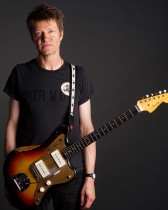
Composer/saxophonist Tim Berne
Wadada’s piece was a whole new learning experience at the time he handed it to us, absolutely requiring him to be there for one early rehearsal. Smith has created his own notational system, and while we mastered it at the time, re-learning it was a major challenge. While the notated lines such as they are can be mastered relatively quickly, the coordination of the group play, the routes that each page take, and the fact that each page is its own unique and intricate progression of events; learning it all again took serious rehearsal time. We had a November 2015 tour in Europe. I was counting on being able to play this work over there a few times to get it back up to speed. But the piece requires multiple horns be played by all of us, and the airlines and post 9/11 security have basically made carrying more than one horn almost impossible, or fraught with anxiety. So Smith’s piece, among others, did not come on tour with us.
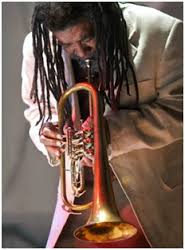
Composer, trumpeter Wadada Leo Smith
As a result we booked a concert in December in the Bay Area to focus on and reacquaint ourselves with this music, and scheduled the American composers on the first night of the Stone week. I’ll give that concert a 7.5 on a 10 scale. The audience was way into it, but from where I stood, I’d heard the pieces played better.
Rova Now @ The Stone - Set 2, Wednesday, January, 20, 2016
The Rova Now set, following the Celestial Septet show, went great. All those pieces had been played in Europe in November. Pieces by Adams, Ackley, and Raskin, plus a Rova piece called Contours of the Glass Head worked really well together as a set. I’ll just highlight Contours here as it’s a group composition that I feel qualified to dissect. This is a piece with literally no notation. It’s instead a list of events. I think of this as a sculpture in sound, as the piece began as a longer series of events that were slowly winnowed down into one coherent, abstract form consisting of 10 sub-sections. Certain elements do return, but in variation.
What I mean by “in variation” is that a section might have the same overall feeling, or shape, or process when returning, but some elements of the section will be changed up. For example there is one section (an idea introduced by Ackley as “Telescope”) which is both sections 5 and 7 in the piece. But over time - in reviewing a performance together, and then taking the piece back in to rehearsal - we made a point of being sure to alter the dynamics in “Telescope 2”. Speaking for myself, I now make sure to alter the way I attack pitches and/or use crescendos and decrescendos, and especially I alter the length of time I will sit on the “centering concert C” that we all sustain over and over. Especially as Telescope 2 anticipates the following “conducted Radar” in section 8, a little more energy in Telescope 2 feels right.
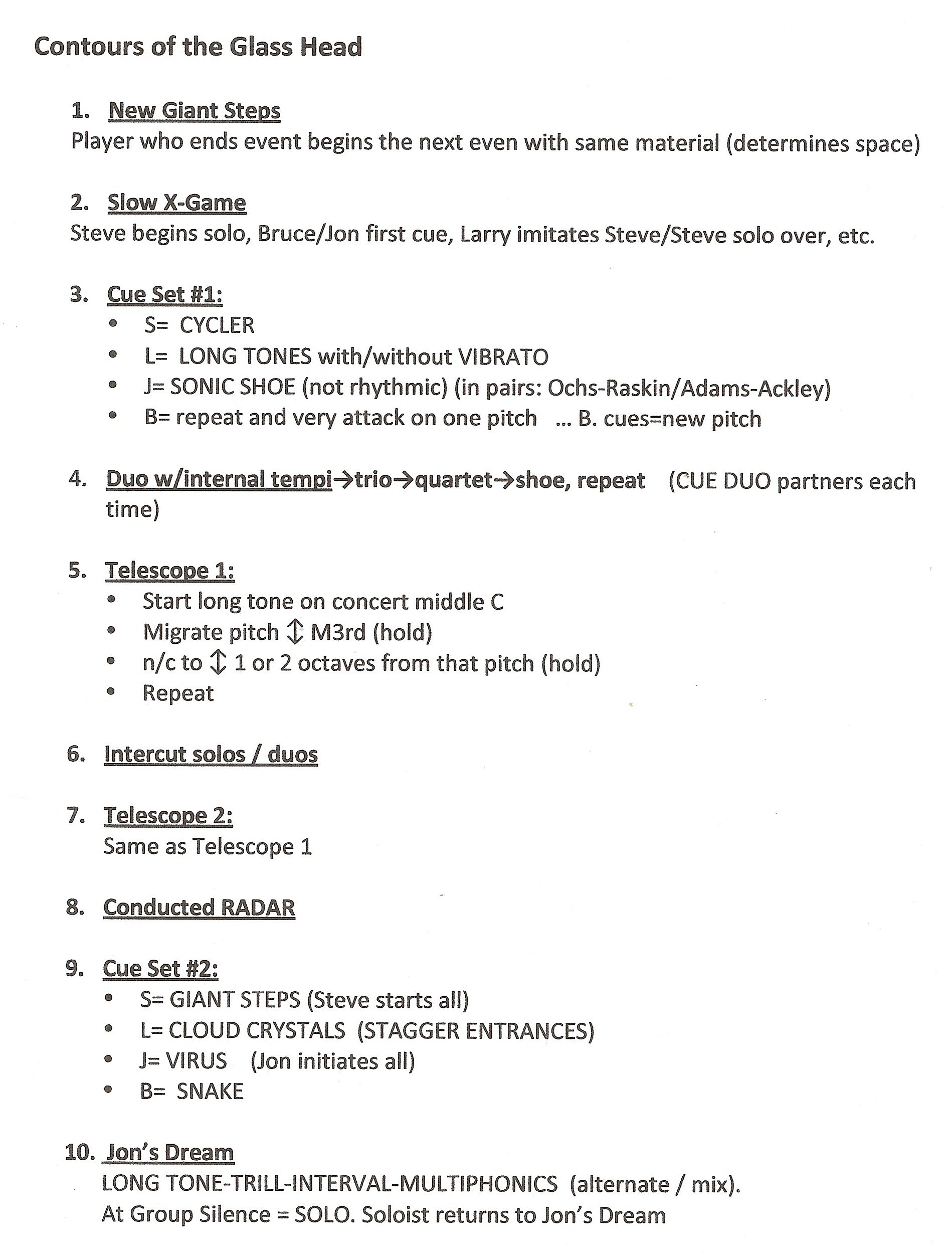
There’s a lot we could talk about in this piece. “Radar.” What’s Radar you might be asking. Radar is a long and ever-increasing list of “process cues” and “sound-specific cues” that Rova has generated over 38 years of improvising and trying o define what happens in music we play or hear, so that we can replicate either the process or the sound-specificity of a section of music we might spontaneously create in concert. Not to repeat it exactly, but to be able to explore that same area again in a different context. In Radar, all these elements are available for “conducted improvisations.’ Specific to Contours of the Glass Head, one player cues in “8. Conducted Radar” and then proceeds to conduct the other three players in what becomes a structured improvisation (or a “conduction” – to use the term that Butch Morris favored.) In a straight-up Radar all four Rovas are expected to issue cues, but here we limit it to one guy feeling inspired to take over, which also frees the other three to be in the moment as players, leaving the responsibility of the improvised “form” of the section - and also the transition to the the next part of the piece - up to the conductor.
And I’ll just explain one more section for now that always works beautifully: “Slow X-Game” (section 2).
“X-Game” is a process cue: there are rules as to how we interact in this game, but nothing else – certainly not one thing about “sound” - is specified. In this case Adams starts the section alone (as Player 1 in the scheme) and creates a motif of pitch or sound that he then works in repetitions that vary somewhat but do not evolve (usually) to a whole new place. Even as the solo extends out, it should remain completely clear what’s at the center of his improvisation. On a pivot-cue consisting most often of a held “chord” or a series of short attacks, player 2 takes over from Adams (Player 1) and imitates that central motif as he interprets it while Adams (Player 1) freely improvises over the motif. On a second pivot-cue by the other players, Player 1 drops out while player 2 and player 3 engage in a free improvisation that can reflect on the previous motif or go anywhere else that the duo involved hear working. On a third cue (by those not improvising), the free duo fades out and then the whole process begins again but it is Player 4 – who up to this point has only been involved in the pivot cues, that is now soloist, as Adams was in the first round. This process repeats until someone cues the group to move on to the following Section. (“X-Game” started out as a process where the “role – rotation” changed very quickly, which made the music much more energetic by default. “Slow X-Game” simply means that the role-rotation must occur more slowly.)
The British Composers Set @ The Stone – Set 2, Thursday, January 21
We chose one piece from a series of many that Fred Frith composed for Rova over a period of years; that set or “suite” if you must, runs well over 70 minutes in total and is called “Freedom in Fragments.” Not sure it was meant to be played all the way through, and I’m not sure that Rova did that, although certainly we played it for entire sets in the ‘90’s. For this concert we picked out one 12 minute piece dedicated to Frank Zappa called T-Square Park Lark. That piece and about 15 others are gathered together on a Tzadik CD released in 2002. One or two of the earliest pieces Fred wrote for us are included an earlier Victo CD Bingo. That CD also includes two pieces by the late Lindsay Cooper as well as the piece we played this night by Barry Guy called Witch Gong Game. The Cooper piece we played, A Face in the Crowd, is a very tonal piece, rather unusual in Rova’s repertoire, and includes a last section for 3 sopraninos and soprano that is teeming with overtones, and sonic beauty as the 4 of us play the same melody ad lib, rather than in unison. The piece also features an awesome spot for me on my sopranino at the top of the piece, playing a plaintive melody followed by a solo spot over two low horns rhythmic repeating lines.
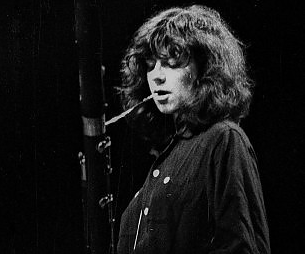
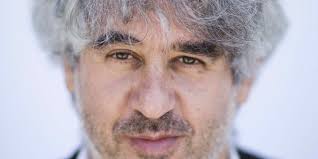
Composer and reed player Lindsay Cooper
The fourth piece that night was one of the last commissions we got before the well ran dry. John Butcher’s piece The Knot Gallery is 25 minutes of sounds, textures and games that set up foils for one to four improvisers to work with and make something happen. We received the music in 2002 and probably had it in our tour book for 5 or 6 years. But it didn’t get played all that much on tour. 25-minute pieces eat up ½ a set, or ¼ of a 2-set show. So a piece that long probably needs an advocate strongly behind it. Personally, I appreciated the concepts, but the construction – I couldn’t hear how the raw elements were adding up to a piece; I couldn’t hear the arc. So I for one wasn’t advocating. And then there’s the simpler fact that in the context of what else Rova had in its book at that time, it might not have been a great fit set-wise. Eventually the piece left the rotation like all pieces do.
As we were doing a set of British composers and as we felt that this piece would work great with the Frith, Cooper and Guy pieces, we took a new look at this piece over last summer. About the second time we played through it, that arc I hadn’t heard 7 or 8 years earlier was totally apparent. All the sections seemed, as if by magic, to flow into and out of each other, and the austerity of the piece was no longer a concern at all. It worked! We played it on tour in Europe a few times last November (2015), and it was received much more positively by our audience. I think that was the case simply because we all heard the piece better, or anyway, simply because the quartet nailed the piece. Something we probably were not doing 8 years earlier.
Barry Guy’s Witch Gong Game is another one of those pieces composed for Rova that fit Rova like a glove, after we mastered some mighty difficult notation and became fluent with Guy’s cueing options. Like Rova’s system that we call Radar, Witch Gong Game includes a set of cues that can, at the option of “the director” be cued in, or never used at all. Unlike Radar, Witch Gong Game includes 8 notated events, 4 graphically scored events and a number of other options including a cue to “play free.” (…also available in Radar). The system includes a “substitute director” who takes over the cueing when the “director” is soloing, and “veto cards” that allow anyone other than the director to refuse a director’s cue. Like I said, it’s a game; it can get contentious, baby. But mostly it’s a lot of fun. There’s also the language system to be mastered. Once fluent in it, then the game is even more fun.
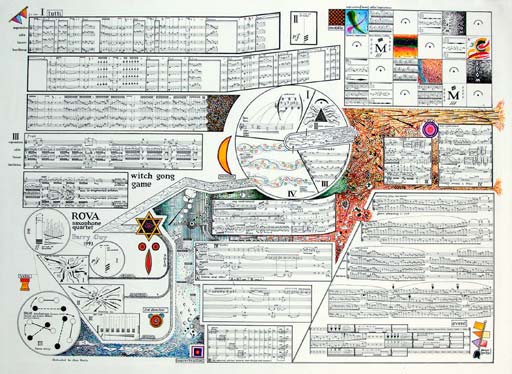
Score for Barry Guy’s Witch Gong Game, 1993
Guy’s piece can be thought of like a Calder mobile; all the pieces are always the same, but the context you hear it in (in the case of Witch Gong Game) can change your perception of it each time. The score for the piece is beautiful; a combination of graphics and notation, all of which can be employed or not in any one version of the Game.
Butcher’s piece is more traditionally composed in the sense that the composer heard an arc and that arc occurs each time the piece is played. I realize now that his piece and Rova’s Contours of the Glass Head (from the Wednesday Stone show) are not so dissimilar in that both consist of a preordained series of events. I think Contours’ sections are a little more open-ended, less predictable, but certainly the two pieces are similar in design, if quite different in sonic results. (Rova has yet to formally record the quartet version of Contours, but a version for 11-piece OrkestRova will be released in October 2016 by New World Records as part of Rova’s homage to Butch Morris.)
All four of these pieces by UK composers had been out of the Rova repertoire for at least 7 years, but overall were less problematic than the American composers’ set to put back together. Plus we were able to take all but the Cooper piece on tour with us to Europe.
Rova “Classic” @ The Stone – Set 2, Sunday, January 24
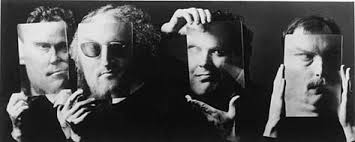
Photo Sharon Beals
Appropriately I think, the final concert of the week was a quartet show. And this one featured some of our favorite pieces by Rova band members written in the earlier years of the quartet. We picked out about 15 pieces we would have liked to do, but the one-set time limitation forced a radical paring down. I think we chose Flamingo Horizon ultimately because we knew we could work it back up quickly as we had played this classic Rova piece this century (penned by Raskin in 1979; performed in 1983 in USSR; revived for Rova’s 25th anniversary concert in 2003.)
The other pieces chosen we felt we could get back together quickly; this was our shit, after all. But the recordings of these older works we were listening to were daunting. The takes of torque and The Unquestioned Answer, recorded on the New Albion CD This Time We Are Both just BURN; they left us with a high bar to reach. This set fit together really well, and I think in the end we delivered the goods here. It was the 11th show in 8 days for Rova, so for certain some mental errors must have occurred, but when you own the music like we do with these Rova originals, you really can make the errors work and massage all the wrinkles out as you fly over and beyond the precipice of the unknown where all the magic lies waiting for (re)discovery. The title of the other piece in this set was Survival in Five Acts. Maybe something close to that would have been the appropriate title for the whole week in New York.
Part 2 of the NYC Residency write up is on Bruce Ackley's Favorite Street
Favorite Street – Larry Ochs - September 2015
Films to See in Theatres Now, or on DVD
Phoenix
Directed by Christian Petzold, 2015

Hot off the Press: Out right now in movie theaters is the film Phoenix. A perfect gem of a movie with some of the most concise and understated acting jobs you’ll ever see, probably thanks to the director and actors wanting a certain tone or feeling to be there as you walk out of the theater. Anything else I say would be a “spoiler.” Or might discourage you from going because you might think “Oh, I’ve seen that kind of film before.” But I will say one thing: it’s only when the film actually ends - where the director ends the story and how it ends - that you realize what you’ve just experienced. Great one.
I have 2 CDs of my own coming out in the 2015-16 season that include 5 pieces dedicated to film-makers. Steve Lacy used to dedicate most of his music to musicians, and in fact I’ve done a bit of that myself. But since 2005 when I dedicated a double CD to Stan Brakhage, I’ve been primarily dedicating extended works to film-makers. My dedications are, I guess, primarily ones of pure enthusiasm, and the desire to turn on music heads to certain film makers, or simply to acknowledge ones (that everyone probably already knows) that have influenced me to be an artist, or stay with it, or both. Not to mention giving me ideas about transition and continuity, which is critical to music. But that’s just half the reason for these dedications. The other half is that I still think music can exist on its own, and one of the great things about music is that the visual aspect is not necessary to enjoying it, but you do still have to be able to see it in your mind in order to hear the music. I don’t want to use the word “understand” as in “understand the music.” Too loaded. Plus, we have way too many politicians trying to get us to understand “the way things should be.” There just isn’t one way. The beauty of music is that there isn’t one way to hear it. So I dedicate music to film-makers to primarily encourage the listener to close their eyes and imagine their own film. I dedicate to film-makers whom I would love to have imagine a film for my music - a “film-accompaniment” to the music - flipping the traditional role: where musicians are asked to make music that works for a film. I think there would be an amazing amount of wild films out there if the music came first.
Most of what I write about here are documentaries or films about musicians in different dramatic situations, but I think in all these films, you could say that the music came first.
Timbuktu
A beautifully shot film directed by the African director Abderrahmane Sissako (works out of Mali), juxtaposing humanity in all its strengths and weaknesses with the horror of an unbending ideology gone completely insane - at least by my standards and the standards of the film-maker. Wow...so many scenes in this movie resonated and repeated themselves in my mind over and over for days after seeing it, scenes including beautiful brave individuals standing up to a band of ditto heads who unfortunately not only have all the power but all the guns and none of the ability to see what they are doing. If you see one film this year, this might be that film, the one you should watch. It's a movie that when described might seem like "it's obvious" and "I already know about that". But it's so much more than the sum of its parts, and so many of the parts are still with me weeks later. Brilliant; haunting; and somehow uplifting, even as it wants to be and is a real warning of one particular horror brewing in our midst. And the interview with the film-maker on DVD is a must-see too. A couple of great scenes including music as well.
Love and Mercy
Bill Pohland, 2015

Beach Boys’ Magnum Opus
There’s never been a better fiction film (based on facts apparently) that gets at the process of creating music than “Love and Mercy”, a bio-pic on Brian Wilson of the Beach Boys. This film is divided into two stories: that of Brian Wilson as an older man, post-fame era, trying to get his life back together, with John Cusack playing Wilson; and that of the early Beach Boys, but primarily focused on the scene around them, and especially the making of what came to be their most respected recording, a Brian Wilson studio-creation called Pet Sounds. Musicians are always attempting to talk about how music gets made, knowing we can’t really “explain” the process because so much of it is in-the-moment inspiration, and that’s the beauty of this film: it gets that. It lets you see that there’s an un-nameable component to creating art that just is, and needs to be made room for. The actor playing the young Brian Wilson is Paul Dano, and he is spectacular in this role. And on top of that you get to re-listen to a lot of great music.
The Wrecking Crew
Denny Tedesco, Danny Tedesco, 2015
The best illustration of how great Love and Mercy actually is? Watch that, then watch the music documentary called The Wrecking Crew, all about the Los Angeles studio musicians who backed Brian Wilson as he was literally inventing most of this music in their studio. These men and women also were the backing musicians for many, many famous pop artists in the sixties who you’ve heard of, or loved if you were a young person growing up then, as I was. It VERY interesting, totally worth watching. Many of these studio musicians ended up having their own great solo careers later on. But then they really can’t replicate how the art gets created the way that a fiction movie can, given the right script, actor and director. But I absolutely recommend this movie to you.
Muscle Shoals
Greg 'Freddy' Camalier, 2015
Similarly, Muscle Shoals, another documentary about backing musicians, this time from Alabama, that has more drama to its back story, and an equally great set of music stars to show us on film. Stars who came first from New York in the fifties and later from all over to play music down in this backwoods bayou town. The stories told on film – wonderful. This one suffers just a bit from trying to make heroes out of the studio producers and musicians. But in the end I liked this one, I think, more than The Wrecking Crew. But then The Wrecking Crew was possibly more essential to see. I’m saying “see them both”, but after you watch Love and Mercy.
What Happened, Miss Simone?
Liz Garbus, 2015

Nina Simone
In the end: an ultra-fascinating story, and includes a satisfying amount of great Nina Simone footage onstage and elsewhere. She was known on tour to be a troubled and troubling presence; “typical prima donna.” Don’t believe it. The story behind her life explains all that, and justifies her attitude too. I left off watching this with one thought: so sorry I never had the chance to see her perform live.
Currently all three of the docs above can be streamed from NetFlix.
Also very much worth checking out:
Leviathan
Andrey Zvyagintsey, 2014
Zvyagintsey, is the director of another favorite film of mine, Elena). In both films Andrey shows that he understands and loves the craft of filmmaking. He takes somber topics and draws you into that world, whether you want to go or not. Leviathan is a film whose outcome is all too real; the result is what you could imagine happening in real life. The film is blessed with a cast of fabulous actors; there isn't one weak link. Even the children in the film are actors of high quality. In the special features accompanying the DVD we see just how adept Zvyagintsey is with the kiddos, convincing one young boy to do a scene over, when the child is very certain that his first take was just fine.
Ex Machina (2015)
I saw this in a movie theater – if I had the time and it were possible, I would always see films in a good theater, at least once. But this one should be great on small screen. It's primarily a thought provoking film rather than visual action-film. Sci-fi heads will love it.
The Salt of the Earth
Wim Wenders, 2015

Well, I saw this in a theater too. I have to say, I’m not sure how this one will translate to the small screen. But the pure intensity of this amazing documentary might be best seen in small amounts, which of course is perfect for that small screen. This is an inspired documentary about an inspiring photographer. Here’s the rap from IMDb: “For the last 40 years, the photographer Sebastião Salgado has been travelling through the continents, in the footsteps of an ever-changing humanity. He has witnessed some of the major events of our recent history; international conflicts, starvation and exodus. He is now embarking on the discovery of pristine territories, of wild fauna and flora, and of grandiose landscapes as part of a huge photographic project which is a tribute to the planet's beauty.” I’m not sure this is yet available as DVD. If you own BluRay, you would have to see this one on that. If you’re wondering how a film about a photographer could be better than actually looking at the photographer’s work in books or in a musuem, watch this movie for the inspiring answer. (Wenders is one of the film directors that gets a piece dedicated to him on my upcoming CD for Tzadik called The Fictive Five.)
The Thin Red Line
Terrence Malick, 1998
A friend of mine and I were talking about films recently, and he said he would love to see my top 25 film list. I don’t have one, and it wouldn’t be very easy to make, but I imagine for sure that this would be on it. I just watched it again recently, looking for films to give to a very young man I know who is considering solving his life problems by joining one of our armed services. This is maybe the greatest anti-war film of all time. (Along with “Phoenix” mentioned much earlier.) And it is so much a pro-humanity film. And no, I didn’t dedicate any of the pieces on my CDs to Terrence Malick. But he is one of my personal favorite directors, and I think this is his greatest film. And this is a great one to see on the small screen. A non-spoiler suggestion: watch the first hour or so, up to the point when our main characters land on Guadalcanal. Take a long break. Watch the next hour or more as the famous battle of Guadalcanal takes place. When the soldiers are back relaxing at the end of it, take another long break and then watch the concluding 45 minutes or so.
Favorite Street – Larry Ochs - November 2014
Films, DVDs, CDs, Books
Filmmaker Vincent Moon
Free documentary films online by Vincent Moon:
Filmmaker John Rogers and I travelled to the Chicago Music and Movies Festival
last May, where Rogers’ two films together called “Channeling Coltrane” were
being premiered, featuring Rova’s 2012 performance of Electric Ascension.
We got a chance to see a lot of other films either framed by or simply about
music. The ones that moved me the most were by a French director named Vincent
Moon. Moon was there; his pre-films rap was inspiring, and many of his films are
as well. Most are under 30 minutes, and many of them are documenting music of
rare shamanic rituals or very cloistered and usually unknown religious moments.
He finds himself shooting in places that most of us wouldn’t dream of even
approaching in the current political climate. You feel watching these films like
you’re right down there with the practitioners. This feeling of intimacy helps
to impress the viewer with its power on the filmed participants. All Moon’s work
is published under a creative commons license. So if you go to his website there
are many, many films there for your perusal.
www.vincentmoon.com
CDs:
Enigmata - John Zorn compositions for Trevor
Dunn-Marc Ribot Duo
12 short but “classic” electric guitar / electric bass duos. Listen to one
of these each morning instead of drinking caffeine; same effect: mind-awakening.
This came out in 2011 but I just tuned in to it. Fantastic playing.
Audio One: An International Report –
Ken Vandermark leads this large Chicago ensemble in a rocking set of
Vandermark pieces. Monster solos from the 4 saxophonists Dave Rempis, Mars
Williams, Nick Mazzarella, and Vandermark.
Ken Vandermark
Audio One: The Midwest School – same band playing 5
classics from AACM composers Braxton, Threadgill, Hemphill, and Art Ensemble of
Chicago. Strong arrangements and playing all around. If you’re a fan of these
composers then you might choose this CD over the first I mention. Both worthy of
your attention however.
Thollem Electric and Gino Robair: Music Minus One (for Dennis
Palmer) – In honor of the late, great synths and electric
keyboards player from Knoxville, Dennis Palmer, Thollem McDonas goes electric on
this CD and, joined by local great percussionist Gino Robair, releases one of
the most compelling CDs of the year. (Not that I’ve heard anything close to even
1/1000th of those releases…) Just out and available directly from the
musicians on
Bandcamp.
Avet Terterian: Symphony #3 - Avet Terterian
(1929-1994) was an Armenian composer writing in the 20th century. I was just
turned on to his 3rd Symphony by local music expert Harry Bernstein. The example
of a performance on You Tube sounds horrible; stay away from that. (But there's
a nice sounding version of Symphony 2 there.) What makes the third so special is
the use of traditional Armenian instruments. But it's a radical composition
structurally as well. Go find a copy! It won't be easy to find but it WILL be
worth your while once you find it.
http://www.terterian.org/en/works/cds/
Phillip Greenlief and The Lost Trio: Monkwork -
Dan Seamons on bass, Tom Hassett on drums and Greenlief on saxophone
inhabit this set of Monk tunes so comfortably, and Myles Boisen’s recording of
them is so clean and intimate, that it’s really easy just to listen and enjoy.
Okay: the structure of the first piece was a little too front and center for me,
but the rest of the CD is totally in the pocket, totally Monk, and totally fresh
at the same time.
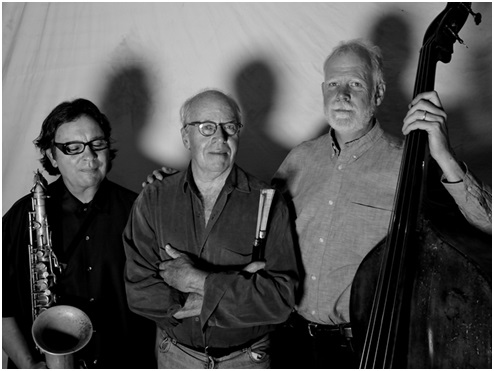
The Lost Trio: Phillip Greenlief, Tom Hassett, and Dan Seamons
Wadada Leo Smith - Louis Moholo-Moholo Duo: Ancestors –
Many of you know my love for horn – drummer combos. I myself have been
performing with one or two drummers a lot over the past 15 years. Inspiration
for this bare-bones formation comes from many quarters, but I can say that the
most influential of these recordings (on me) were almost all heard relatively
early in my musical life. Wadada and Moholo’s duo performance, recorded in 2012,
immediately jumps into the upper pantheon. It’s simply a must-listen; meditative
grooves laid down by Moholo for Wadada to improvise perfect melodic inventions
in sound and silence. Released on a Finnish label called Tum. Available
online for sure. Music doesn’t get more direct and mature than this. Now my
recommendation is, I assume, going to directly compete with my own duo CD with
drummer Donald Robinson. It’s forthcoming in late November 2014 on the Polish
Not Two label, but Ancestors just blew me away—a present that any
friend with serious interest in music will appreciate.
Sun Ra: Live in Nickelsdorf 1984
A triple CD from Sun Ra's 1984 European Tour, here performing live at
Jazzgalerie Nickelsdorf (on Austria-Hungary border) for an ebullient set of Sun
Ra originals and standards with the Arkestra—including John Gilmore, Marshall
Allen, Danny Ray Thompson, James Jackson, etc. Terrific spirit and a very
immediate live sound. All the instruments have a presence as if you are
listening from the front row of the audience. High quality. Sun Ra himself gets
lost in the sound when all the horns come in, but that one flaw aside, if you’re
a Sun Ra fan, this is one to have.
John Zorn: In the Hall of Mirrors - Very cool
combination of through-composed piano writing, played with great feeling by
Stephen Gosling, and an accompanying rhythm section of improvisers Greg Cohen on
bass and Tyshawn Sorey on drums. Your basic piano trio, one that Bill Evans
would have been proud of. Playing on the edge, of course, or I wouldn’t list it.
Sorey is particularly memorable. Compositions by John Zorn. You can hear samples
of this music on Squidco, an excellent CD store online.
John Zorn, In the Hall of Mirrors
FILMS:
Pride—a
really fine British film, based on a true story. It’s got a bit of a Hollywood
vibe to it, but every time something happens that’s too good to be true, you
remember: TRUE STORY! And a historically important one; quite moving in
many ways. The ensemble acting is pitch perfect. (You could also wait for the
DVD on this one in that it’s all about the acting and the story rather than
about the cinematography.)
THE SQUARE
- POWERFUL look at the attempted (and ongoing) revolution in Egypt. Uplifting in
all ways. Heartbreaking in some ways. Sure: you already know the whole story.
Actually: not at all. I’d write more but basically: you owe it to yourself and
to them to check this one out. You can watch it 15 minutes at a time without
losing the thread. The main characters of this doc are unforgettable, and very
brave.
John Cassavetes, A Constant Forge
- great, great, great - but perhaps overly long (though I
wouldn’t know what to cut) – documentary on the work of the artist as a young
man, a family man, and an older man. The artist in this case is John Cassavetes
and the doc is about his films and his role as director of those films and
inspirer of the actors in those films. This is essential viewing for
anyone interested in any art form. It might be better to have recently watched
Faces and Shadows, his first 2 films, or his
masterpiece (perhaps) A Woman Under the Influence. These films
take no prisoners; the intensity of the acting and the subject matter is ...
compelling? Riveting? Threatening? They are an experience, and if
you think you "remember" them from first viewings in the sixties or seventies,
yeah: watch them again now. You don't; it will be a thrilling experience, if
sometimes too intense. Another reason I love well-made DVDs or BluRay; they look
great, and you can turn them off and take a break if the content becomes
too intense. Watching Cassavetes’ films in advance of watching the doc
makes it better, I think. But then watching the doc might make it more likely
you do watch the films. Don't hesitate. There is so much to think about
in both his films and this documentary. All of these films are available in a
box set from Criterion, or sold separately too, I believe.
The
Act of Killing: Erroll Morris and Werner
Herzog are executive directors of this film. Perhaps that's enough to tell you
that you should check out this BRILLIANT (!) absolute shocker of a documentary.
No, no: don’t worry about visually upsetting acts of killing; it’s the morality
of the film itself that’s so interesting and controversial. Reading about the
very basic background won't spoil it for you: The Philippines army overthrows
the government in 1965 and puts in place a military dictatorship. Anyone
protesting or otherwise dissenting is proclaimed a Communist. Communists
can be killed without punishment. The army hires members of the country’s
gangster class to hunt down the Communists, which they do with no holds barred.
Something like 40 years later, the film-maker of The Act of Killing finds
and interviews two of the gangsters hired by the army in the sixties; they
willingly describe their exploits. During the interview, he is so blown away by
their stories (and the patriotic tone in which they tell them) that he suggests
that these two guys make a movie of it to show that they were in the right in
their actions. The gangsters decide this is a great idea. But they don't need a
director; they can do it themselves. They've watched many movies. So the film
you watch is a combination of interviews plus the filming of the gangsters
turned film-makers creating their own film with themselves as lead actors,
playing the roles of both the victims and the "hero" collaborator-gangsters,
playing male and female roles, featuring the use of crowds of current Filipinos
playing the Communists being chased down. The issues raised, the morality of it
all, the interviews with real participants of the sixties carnage is all
combined into something much bigger than the sum of its parts. Just think Erroll
Morris and Werner Herzog docs. If you’re fans of those….
Stories We Tell
by the Canadian actor and director Sarah Polley could not be more different in
tone, feeling and emotional impact from The Act of Killing. But it too
posits all sort of questions about "the truth." Polley, who directed Julie
Christie in the powerful "Away From Her" some years ago, here interviews all of
her siblings, her father and others about her own mother, who passed away when
Sarah was eleven, leaving behind a mystery that is solved by this film. Using
found footage of home movies, the interviews and then acted reconstructions of
some parts of "the stories," all in a completely seamless, incredibly
well-edited montage, the mystery is revealed, and looked at from many different
perspectives. Personally I think this was one of the best films of 2013. But I
can't talk much more about it without giving away what develops. Let's just say
that you will be touched.
DVD
Short Term 12
- It never ceases to amaze me the films that get by with little notice. All the
hullabaloo about annual “Best Film” that stretches from late November until the
Academy Awards. And yet every year there's one film (or more) that gets
absolutely no mention, but should have. Here's your 2013 most under-rated. I
just saw it streaming from Netflix. It blew my mind. Particularly the acting.
The lead role is filled by a young master. But everyone shines. It feels
completely real...unnh.. except for the fact that all the stories told end up
here with happy endings, or relatively happy endings. But maybe that's one
reason I ended up liking it so much. A gritty film about young adults and older
kids trying against all odds to get their shit together, and in the end, they
do, or at least appear to be heading in the right direction. In other words,
whoever wrote the script must have lived the life first. Beautifully done all
around.
ONLINE:
The Reckless Moment
(1949) with James Mason and Joan Bennett, directed by Max
Ophuls, and you can watch it for free!! What the hell right?
http://putlocker.bz/watch-the-reckless-moment-online-free-putlocker.html
Ophuls takes the American dream of the late forties and tears it asunder,
especially focusing on the American woman and mother in post-war (and fifties
era) USA. A fine performance from James Mason. But my favorite part of this film
is the (limited) role/character of Joan Bennett's teenage son. Oh yeah: the
1950’s—may they rest in peace.
BOOKS
24-7: Late Capitalism and the Ends of Sleep by
Jonathan Crary. A 100-page book that lays out the 21st century
scenario under which all of us are trying to make sense of our lives. Incisive,
convincing, and illuminating. And as densely as the ideas come, it’s a true
page-turner.
Barry Unsworth:
Sacred Hunger
(1992) centers on the 18th century Atlantic slave trade that moves from
Liverpool to West Africa, Florida and the West Indies. It was joint winner of
the Booker Prize for Fiction in 1992. The novel's central theme is greed, with
the subject of slavery being a primary medium for exploring how selfish desire
for profit can result in evil and barbarism. The story line has a very extensive
cast of characters, some featured in only one scene, others continually
developed throughout the story, but most described in intricate detail.
Beautifully written, deeply moving, page-turner.
Archival recommendations:
CD: Ray Charles Sings Basie Swings. Released by Concord on October
3 rd, this is a true 21 st century recording. For details on the bionicity behind
the music, you can go to Amazon.com
or to any site selling the CD, but this is truly an instant classic. Charles sounds
incredible!
DVD: Gloomy Sunday - Oh baby; pull out the handkerchiefs. You know
I'm the guy recommending things like Bela Lugosi box sets, but here we have a perfectly
acted and very moving Hungarian film taking place in Budapest and centered around
a song. Namely "Gloomy Sunday," sung by (among others) Billie Holiday.
The acting, in particular by the woman at the center of the film and by the actor
representing all Germans, is superb. The whole story feels real, and maybe it was.
Website: Pandora - Interested in finding out about
a musician or other musics related in some way to that artist. You could have a
fun time at Pandora. Check it out.
Website: Paris Transatlantic. It's true: the CD review in this
issue of the newsletter is from this webzine. But this isn't payola. Paris Transatlantic
is actually a good place to learn about what's being released on CD not only in
improvised music but also from "related" avant garde or non-commercial
artists. And the articles are often worth checking out too.
The Read: Steve Lacy's Conversations.
- Edited by Jason Weiss. Rova spent a lot of time around Lacy, so it's
with great anticipation that I have just received this collection of interviews
and "conversations" taking place from 1959- 2004. From the back cover:
Conducted by writers, critics, musicians, visual artists, a philosopher and an architect,
the interviews indicate the evolution of Lacy's career and thought." No; as
you can tell I have yet to read it but I have full confidence that there will be
plenty of pearls within this book. From Duke University Press.
Favorite Street: Larry Ochs
DVDs
Chen Kaige directs The Prophet
Ever since Crouching Tiger, Hidden Dragon, the artier film directors from
Asia have been turning out high-end fantasy / action films. This was made in 2005
and was very hard to find in the USA for awhile–I own a Hong Kong copy–but
it appears to be easily available now. One of the lesser known of this genre, but
with absolutely beautiful cinematography, The Promise is a deluxe version
of a folk legend, with all the lack of logic you also find in European fairy tales
and folk stories. The original very long version is the one to see.
Francesco Rosi directs Salvatore Guiliano …and now for something
completely different. While watching this exquisite black and white remastering,
I assumed I was discovering another Italian neo-realist film, but in fact this film
dates from 1962, and according to some notes I read, was the major influence on
Gillo Pontecorvo, director of the better known “Battle of Algiers.”
(Both films have been remastered beautifully and released on Criterion.) So: “realist
film…?”
The first 10 minutes and the last 20 minutes are virtually documentary in style.
In between you get one high contrast and unforgettable black and white shot after
another, and terrific editing. The “story” doesn’t matter, but
in case you care: Giuliano at 23 became the head of the resistance in Sicilyafter
World War 2 (so resisting Italian unification) and eventually was gunned down by
an informer. But what you love about this film has nothing to do with the narrative
details, but rather the visual details and the editing from scene to scene, as well
as sense of place.
Book
R. Buckminster Fuller: Synergetics: Explorations in the Geometry of Thinking.
This re-investigation of a sixties icon had been something of a move of desperation
for me. I was so bummed by our political leaders and the entire aura of fear and
negativity that they have successfully generated, that I was looking for someone
or something positive to read in the non-fiction realm. I remembered Fuller’s
hyper-optimism and thought I’d see if it still read well. It reads much, much
better for me now than it did in the early seventies. Synergetics is the third book
I’ve dipped into, and I can’t say this is the best introduction to his
world—very dense, literally lists of thoughts…but it’s the most
complete picture of his ideas, and full of things to think about. It’s also
been reprinted by the co-author on line, so you could dabble up there. At 724 pages
though, eventually you’ll have to pull the trigger and buy a used copy. (There’s
no sign of this book coming available anytime soon.) His ideas make too much sense
for that to happen!
http://www.rwgrayprojects.com/synergetics/toc/toc.html)
DVD-ROM
The Magical World of Joseph Cornell
While on tour on the East Coast two weeks ago, Rova found itself with two entirely
free hours in Washington DC. On a tip we made our way to the Smithsonian and caught
a—a what? Yes, a “magical” exhibit of Joseph Cornell’s
works. Also on display there was the above-mentioned DVD ROM which you can find
online at http: //www.voyager-foundation.org.
Here is their introduction to this DVD-ROM which I thought was pretty special and
perhaps the next best thing to seeing some his works in person.
Note: This disk does NOT contain the entire exhibit, but what
it does show you, it presents beautifully.
“Joseph Cornell (1903-1972) was one of the most important American artists
of the twentieth century. In his boxes and collages, he assembled a mixture of bits
of popular culture, classical art and literature, obscure scientific texts and theories,
creating compelling formal and playful, interactive private worlds. Composed of
earthly, often humble, cast-offs, Cornell's work is frequently transcendent, evocative
of dreams and pointing to the heavens.
The Magical Worlds of Joseph Cornell DVD-ROM offers unprecedented access
to Cornell's work, providing multi-dimensional views of some of his best boxes.
This intimate exploration gives a virtual hands-on experience of these objects as
well as a unique insight into the artist's working materials and methods.”
Favorite Street: Larry Ochs
Ochs says: Things for you to check out in all that spare time you all have:
Mills College Music Department rarely gets the credit it deserves. The place has
been a center for experimental music forever at this point, but the main thing about
it through all these years is that the department is always importing great artists
into the Bay Area, something that pumps energy into the cultural firmament at the
same time that it draws interesting students to study, who then stay on and mature
here, all in all adding greatly to the possibilities around the musical Bay. I could
lay out all the names over the past 50 years but I’d rather just like to thank
them once again, this time for bringing in Zeena Parkins for six
months and Roscoe Mitchell for the next three years! And Rova:Arts
will have both of them "informing" you of their own respective musical
concerns at Improv:21 events later this season. Now if we could just get Mills to
do a better job of publicizing the school's music concerts...
Il Lee is an artist from Brooklyn. All his drawings, and there are many, are created
entirely with ink and that ink is put to paper using Bic pens. Dense, intense meditations.
I saw a huge collection of his work in San Jose just before the show closed last
month. But the books, while not as astonishing as the live viewing, are quite beautiful.
www.youtube.com
gets you the preview for the show that is gone from SJ.
The Grand Piano was a café/hang-out in San Francisco that hosted poetry readings
in the late seventies; 10 writers who read there and also became part of a loose
group that was tagged as "the language poets" have been and continue to
compose a series of chap books called The Grand Piano, reminiscing about
that era but also doing a lot of thinking about the art, the politics of then and
now, and the cultural life of San Francisco and beyond. The Grand Piano
describes itself as "an experiment in collective autobiography." It was
begun over email by ten poets identified with Language poetry, who sought to reconnect
their writing practices and to "recall and contextualize events from the period
of the late 1970s." When completed, The Grand Piano will comprise
ten parts, in each of which the ten authors appear in a different sequence, often
responding to prompts and problems arising in the series.
thegrandpiano.org
Dohee Lee is a performance artist and vocalist from Korea now residing in the Bay
Area. Her vocals have impressed me to the degree that I have formed a new group
including her, designing ways to work up compositions inspired by Asian art and
traditional music. But you might want to check out her own performances when you
can, whether she's working with me or not. I've seen her solo performances, and
they are quite powerful. And she appears with Kronos at SF Jazz Festival in October.
Films on DVD:
The Intruder was William Shatner's first film, and it was directed
by Roger Corman. Corman is known exclusively for his many "great" horror
films, often made on very low budgets. But here he takes on racism in the South
as Shatner portrays a young man bent on stirring up a small town to a lynching and
wreaking... A little known, but very well done black and white film from the early
sixties.
The Naked City is the police movie that spawned an entire genre.
The TV show Law and Order does not exist without this movie, for example...
Shot on the streets of NYC in the late forties, it is an absolute classic and the
cinematography is terrific. Rent it only if you can find the release from Criterion;
a great job of digital renovation. Also worth mentioning in a similar vein: Crime
Wave (1954), a cinematographer's dreamscape; Weegee - like crime scenes are
everywhere in this film, although the available print isn't nearly as well restored
as that of The Naked City.
Away from Her just departed from Bay Area theaters but should be
released soon on video. Julie Christie stars, and she is absolutely as brilliant
as she ever was back in the sixties and early seventies. When you see this film
try to remember that the director was only 28 when she made it. Clearly Sarah Polley,
the director, is some kind of genius, but if you've seen her acting in other films,
you already knew that. Don't be put off by the fact that Alzheimer's disease is
at the center of the film. This is a great story and if you find yourself crying
at the end of the film it won't be because of the course that the disease takes,
but rather because of what this film reveals about human communication and the difficulties
of doing the right thing. Brilliant.
CD to look out for:
Okkyung Lee is a cellist now residing in New York City. Also Korean-born,
she is one of the most exciting performers to emerge recently. She also has a very
excellent CD on Tzadik Records entitled Nihm:
www.tzadik.com. She will be performing at Stanford in January.
Favorite Street: Larry Ochs
No news is good news
I just finished reading The Shock Doctrine by Naomi Klein. “Just
before” that I attempted to read all of Blackwater by Jeremy Scahill.
The Blackwater book is the unauthorized history of one of the major benefactors
of the private war in Iraq. It’s an unpleasant read in the sense that it tells
you way more than you want to know about what your government is doing in your name,
but everyone would do well to check out the first and last chapters, in case you’re
still unsure about what’s continuing to go down there.
The Klein book is a masterpiece, a must read really, that – if people were
framing the debate about Iraq and foreign relations in this way in general –
would completely close out any arguments of our right/need/ mission abroad. But
it’s a very, very difficult read.
The first chapter hits you over the head pretty hard, and each chapter following
is blow to the psyche of any American (from the United States; if you’re a
South American your reaction will be quite different), at just how extraordinarily
much evil there is in our country’s very recent history. I would read maybe
one or two chapters and then walk away for a week before I could take it on again
What’s amazing and totally unexpected is that in the final chapter, Klein
radiates hope for the future, and really gives hope that an end to all this madness
might be not so far way. Check it out.
And from Russia with love
I AM CUBA is a great film that many of us discovered when Milestone
Films discovered and restored the film in 1995. Milestone released the film in a
new print for DVD late last year, and I would say that it’s even better on
DVD. The film is a fictionalized, panoramic view of the Cuban revolution as seen
through the eyes of Russian director Mikhail Kalatozov and cinematographer Sergei
Uruzevsky, both of whom visited Cuba, fell in love with the people, and filmed this
amazing work in the early sixties. What makes it so great on DVD is that one can
watch scenes with total concentrated intensity, and then as soon as your concentration
begins to flag, turn off the box, returning to it with fresh eyes a little later.
In other words, the film, for me, doesn’t really work when watched all at
once. The pacing is just too slow, but each scene or vignette taken on its own is
incredible, beautiful, poetic. And speaking about music, the early scene in a “club”
there is extraordinary musically- (and visually-) speaking and worth renting/buying
just for that. Definitely a film worth seeing more than once...
But what’s really invaluable about this new Milestone deluxe boxed set is
that it includes an excellent and comprehensive documentary of the director. The
film highlights of his other films contained in this doc are absolutely breath taking.
As soon as I could I rented his film “The Red Tent” about a mission
to the North Pole that goes awry. Shot pretty much entirely at the North Pole in
rugged conditions, this was Kaltozov’s one “international” major
film, and as such it stars Peter Finch, Sean Connery, Claudia Cardinale, and a slew
of unknown (to me) but excellent Russian and Italian actors, with a killer soundtrack
by Ennio Morricone. Kind of a spaghetti western vibe twice removed to the North
Pole and sifted through the mind of a Russian. Great… And then there’s
the film “The Cranes Are Flying,” another Kalatozov film just released
on Criterion. Haven’t gotten to this one yet, but if the rest of the film
is anything like the clips in the doc, well I can recommend it now just based on
the clips.
Recommended listening:
The Advocate (Tzadik) Derek Bailey, the great improvising guitarist
who died in 2006, and Tony Oxley, still going strong and performing
often with Cecil Taylor, recorded together in 1973. Those tapes have been released
now on Tzadik; remarkable. But perhaps the strongest piece on the CD is Oxley’s
solo piece recorded in 2006 and dedicated to Bailey, including his electronics set-up.
It’s absolutely riveting and of course uses “space” – the
silence between the sound that was so much a part of Bailey’s playing aesthetic
– to beautiful effect.
Carla Kihlstedt / Satoko Fujii – Minamo As you may
have seen earlier in the newsletter, Carla Kihlstedt now has a commission to write
a large work for Rova in 2010. If you’re reading this newsletter, it’s
fairly certain you’ve heard Carla perform, but less certain that you’ve
heard Satoko or this duo. In fact Rovaté 2002 (Rova:Arts annual collaborative
event) featured a big band version of Orkestrova with all music composed by Satoko
Fujii and Steve Adams. At that event we also heard this duo for the first time,
and a good portion of this CD comes from those concerts, recorded at the time by
KFJC; the rest of the CD is from a live concert in Wels where I invited them to
see if they could make the magic happen a second time. Now you get to hear these
beautiful violin, piano duets which deftly mix the feeling of the classical violin-sonata
formation with the aesthetics of improvisation; sublime music deftly mastered by
Myles Boisen.
Maybe Monday- Unsquare (Intakt)– Elsewhere in the
newsletter is a mention of my new self-produced CD The Mirror World. But
if you can’t handle a $65 collector’s edition and plan to wait for the
“normal” release in May, let me recommend a brand new release I produced
for Intakt with Maybe Monday. Miya Masaoka, Fred Frith and I started
performing as a trio in 1998. In this configuration, Miya plays not only her koto
but also an arsenal of electronics and digital sounds and effects that are triggered
by the koto strings. For this recording we went into the studio with special guests
Carla Kihlstedt (violin and efx), Gerry Hemingway
(drums), Ikue Mori (electronics) and Zeena Parkins
(el harp), and recorded 8 septet pieces in 3 hours, five of which made the cut for
this CD. It’s a series of landscapes or tone poems that make up a beautiful
arc, in my humble opinion, and comprise a fine example of free improvisation at
its best.
Photography: Chris Marker
Chris Marker, the legendary film-maker now in his ‘80s has
just published a new book of photography called Staring Back. Go find it. Both the
brief texts and the photos in the context of those texts are quietly stunning.
Anthony Braxton observes an Adolph Saxe creation
I got tipped off during the summer by an excited comrade that Mosaic Records was
collecting all of composer Anthony Braxton's records for Arista
Records, made in the 1970's, into one CD Box-Set for release in October; folks:
that's now! www.mosaicrecords.com. The
news came at an interesting moment: I was poring over the DVD extras of Julie Taymor's
most recent film work – Across the Universe. That's Taymor's film-musical
dedicated to the music of the Beatles. And I was musing over the fact that the Beatles
were, much to my surprise, a key influence, if not on my personal work, at least
on my outlook on life; frankly that did surprise me. So on this take of Favorite
Street, I'm going to direct you towards some media that can give you some insight
into influences from the sixties and seventies upon my own and Rova's work, past
and present, my own playing/thinking, and the creative process in general.
Here's what I'm recommending to all of you with all your free time:
- CD: Wadada Leo Smith: Kabell Years 1971-1979
- CD: The Complete Arista Recordings Of Anthony Braxton (8CDs).
- CD: The Art Ensemble of Chicago: Baptizum // People in Sorrow
// Les Stance et Sophie
- CD: Steve Lacy: Scratching the Seventies
- DVD: Julie Taymor's film: Across the Universe
- CD: Cecil Taylor: Dark to Themselves and Conquistador
- Online reading: Synergetics by Buckminster Fuller
- finally: DVD: Musician, featuring Ken Vandermark
Braxton, Lacy, and Mitchell
Anthony Braxton, Steve Lacy and Roscoe Mitchell were probably the saxophone players
I was most inspired by in the early seventies. I'm not saying I sound like any of
them, but their individual attitudes (or perhaps my perception of their attitudes
of "refusing to compromise" on their art, playing music they believed
in) was something I couldn't get enough of. Some of the records now in this box
set of Braxon's from Arista, I played many, many times: New York, Fall
'74 and Creative Music Orchestra especially. And, of course, seeing
all these cats play in the Bay Area or in Paris (in Lacy's case) early on was very
important.
For me as a saxophonist, a "key solo" was Roscoe's on The Art Ensemble
of Chicago's recording made live in Ann Arbor called Bap-tizum. I transcribed that
one; and I also copped his mouthpiece, which I learned about from Andrew Voigt when
he moved here in the late '70's and joined Rova. But what you learn as you get more
into it is that the players who you are most attracted to are those whose voices
are close to yours, as opposed to the other way around. That is: the whole point
of making music is to discover your inner voice and to allow that inner person the
leeway, the trust, to take you out. Music making, at its highest level, has the
same goal/outcome as meditation: to discover the way out into the aether where you
do no wrong and your energy is replenished even as you (in music's case) put out
that very energy.
The beauty of making music is that as it takes the player to heaven it can also
actively transport some of the listening audience along with you. (In fact there
are times when people in the audience lift off further than the musicians, but in
that case then we are more like the booster rocket for the audience-as-payload heading
to Mars...) Thinking of Lacy too right now, whose composerly influence was primary,
I recommend the CD compilation Scratching the Seventies.
I loved this period of Lacy's, quite likely because the '70s is when I discovered
his music. But it is true that Lacy in the '70s combined artistic attention to detail
with wildly uncontrolled experimentation in his music, or in his bands' interpretations
of his music, and this led often to exhilarating results that happened less often
in later decades.
The Art Ensemble of Chicago
The AEC was perhaps the key band for me in this period. While I always loved Braxton's
music at that time, the Art Ensemble's palette included a folk element that to this
day I am attracted to, and I have really enjoyed including recently – but
in my own way - in music for bands like Kihnoua and Larry Ochs Sax + Drumming
Core as well as in some Rova pieces like the one dedicated to Albert Ayler
written for the septet of Rova plus Nels Cline Singers... So the Art Ensemble had
the rigor of Mitchell's ideas combined, I think, with influences and musical elements
from the other composers in the band. Their first sighting for me in 1973 in Berkeley
(in an amazing double bill with a Charles Mingus band) was a major confirmation
of ideas I was then focusing on, as well as confirming other ideas I hadn't even
had yet but were waiting there for me in the concert hall that night—ideas
I still grapple to control.
CDs of theirs that I still listen to occasionally, but that I listened to many,
many times and can still heartily recommend include (but would not be limited to):
People in Sorrow; Les Stance et Sophie. Taken together with Bap-tizum you
get a very good picture of this band from these 3 recordings.
Wadada
And as long as we're on the subject of AACM influences, my first sighting of Wadada
Leo Smith came not too long after the above mentioned musics, and you can actually
hear yet another pioneer playing his 70's music on the fantastic Tzadik release
from two years ago called Kabell Years 1971-1979. Kabell was Smith's own
CD label, and his self-releasing of his music had to be one of the inspirations
for my starting up Metalanguage Records in 1978.
Mr. Taylor
Then, a thank you to Henry Kaiser for recently suggesting I listen to the Cecil
Taylor CD Dark to Themselves for the first time in decades. Yes Henry,
this could make for an interesting sequel to Electric Ascension. Rova produces
special projects each year, and many of them involve Orkestrova which is the 4 Rova
sax players plus whatever expanded instrumentation we take on to fulfill a certain
musical goal.
Cecil Taylor was someone I discovered and seriously checked out in 1969 while working
at the student-run station WXPN at University of PA in Philadelphia. I did a blues
show, but the jazz titles were all there in the same part of the LP shelves, and
one night I pulled Cecil Taylor out. At first it was all about the energy. My favorite
music was rock, but bands like (the early version of) Fleetwood Mac and the Stones
were directing me to the original blues musicians. But the raw energy of rock led
me to immediate interest in Taylor and Sun Ra (who played a lot in Philly then),
once I got turned onto them. The Taylor LP I was particularly into in 1969 was Unit
Structures.
It's funny for me to think that at the time, I heard no detail in this music; it
was the energy I heard. Whereas at this point I can hear every detail, every note.
Dark to Themselves came out later, but the ensemble play and the lines Taylor has
the horns playing etc. are inspired and might be a lot of fun to reimagine for Orkestrova.
Julie Taymor: Across the Universe
The Beatles are huge for anyone who grew up in the sixties, and just about anyone
who grew up after the sixties. It's funny to say that because, by the late sixties,
I wasn't interested in them much anymore. I was a Rolling Stones fan. And I would
not have expected even now that I would, in the year 2008, be open to the idea of
revisiting their music. I'd pretty much lost my appreciation for them since the
release of the film Yellow Submarine, which I enjoyed at the time, but after that
I stayed away.
So I went to the Taymor film because I love her film-making, (...if you never saw
Titus, based on Shakespeare's Titus Andronicus... a wondrous film
experience is there waiting for you...), and there are certain film-makers I will
check out every time in theaters because, while DVDs are convenient, I still prefer
seeing a film on a big screen. (Films on IPods? I don't get that at all.) Taymor's
film was really enjoyable in the theatre. But I wrote off my response mostly to
the need I had that particular day to sit in a dark room and absorb.
Could have been any movie. However I did admit to myself that those Beatles could
really write music. The lyrics were very touching in part, and the music writing
was revealed in a very new way by this film. Or so I thought at the time.
Buying the DVD in this case was kind of a revelation. Being in a movie theater with
the big screen in the dark will always be my favorite way to see film, but the DVD
medium has many positive aspects to it. First of all, after you watch a film all
the way through the first time, then after that it's absolutely fantastic to see
it in small increments. The best movies are like books. Too much detail going by
for one sitting, at least in serious concentration.
Across the Universe is not a really deep film in most ways. But one thing really
comes across on DVD: Taymor has really captured the spirit of the '60s, especially
the 60's on the East Coast. Now the storyline almost doesn't matter in this film;
it is after all a musical. But the underlying tone of the film is a direct hit throughout
and really very moving. The combination of the Beatle's naïve optimism and
the true (and frightening) uncertainty of the times were captured incredibly well
by the Beatle's lyrics and music, at least as framed by the film.
So I'm not sure which came first, the music or the frame, but in the end I was very
moved, and if you lived through those days, I think you will be too. In any case
there are minutes throughout out the film of breathtaking editing or montage that
are worth sitting through all the rest of the film. But "the rest" is
all music, and fantastically done for the most part.
The DVD extras are fantastic. Taymor does the commentary herself, and for once a
director takes the job seriously and really gives you a lot of information about
how she thinks and works. There are also some well-done docs on the choreography
in the film, and in the end I learned a lot about making movies. Finally the out-takes
of the music scenes are worth the cost of the DVD by themselves; perhaps my favorite
was the out-takes segment of Eddie Izzard doing his Mr. Kite scene. He's improvising
the vocalise as he goes along... "structured improvisation" (of a kind)
at its best. Watching his raw takes, and then going back to the film to see the
finished product: illuminating...
Buckminster Fuller
 |
|
|
The only person from the sixties more wildly optimistic than the Beatles or Anthony
Braxton was Buckminster Fuller. Fuller (1895 – 1983) was just the subject
of a major retrospective at The Whitney Museum in NYC. But he wasn't an artist per
se. He "was an architect, engineer, philosopher, futurist, inventor of the
famous geodesic dome," and inspirer of many, including Stewart Brand and the
Whole Earth Catalogue; simply a brilliant creative mind. When I first moved to California,
I lived for a few years in the wilderness of Mendocino County; we built a cabin,
but there were geodesic domes on that same property, purchased through that very
Whole Earth Catalogue. And the geodesic dome was Fuller's idea... His philosophy
was at that time quite in contrast to how many of us felt, how many of us saw the
USA and the world. He went from university to university at that time speaking to
thousands of people at a time in 4-hour monologues about "Spaceship Earth."
He felt at the most basic level that governments preached scarcity in order to divide,
when in fact there was (and continues to be) more than enough for everyone to be
comfortable on the planet. He tried to come up with innovative designs that would
do more with less.
I've been thinking about Fuller a lot in the past 2 years, trying to draw from the
spirit of Fuller's overall outlook in designing a process for the next Rova collaboration:
Rovaté 2009 (May 22 and 23, 2009 to take place at Kanbar Hall at Jewish Community
Center San Francisco). Rova will collaborate with some great musical improvisers
as well as the media and digital-animation artist Lillevan, a true innovator from
Berlin, Germany, who enjoys creating film works "spontaneously," much
as Rova creates music. His film-making includes improvisation, using images and
found footage he has compiled for the specific project. So, my mentioning Fuller
also acts as a heads up for these May San Francisco performances. More on those
shows in one of the next newsletters.
For now: you can go online to read Synergetics
rwgrayprojects.com and take a long look around at all the writing in a book
long out of print. Some of Fuller's books like Operating Manual for Spaceship Earth
are being reprinted now. But I think this one, read in small doses, casts up a lot
of food for thought.
Ken Vandermark
Finally, off the theme of "early inspirers," I can recommend a film that
I just saw featuring the Chicago saxophonist Ken Vandermark: a one hour documentary
called "Musician." It's one in a series of documentaries by Daniel Kraus
called "The Work Series." Shot in a cinema verité style, it really
will give you a realistic version of what it's like to be an improvising musician
trying to get by at this time, focusing on touring in all its grime and glory as
well as on working up the actual music.
Rovaté 2009 and Buckminster Fuller
Fissures Futures was conceived in 2005. We were hoping to find the funding
for it in time for a 2007 or 2008 show; but here we are in 2009. While for me personally
life has been good in this period, during this entire decade our federal government
was committing all sorts of crimes against humanity, in all of our names. This is
only my personal opinion, but I’d say things had been sliding since the advent
of Reagan in 1980. Since 2000, the slide had turned into an avalanche of horrible
deeds, lies, and cynical acts. So I wanted to produce a show that flew in the face
of those acts – but not in an overtly political performance, because that’s
not what we do.
Instead, simply, to produce an inspired work by people brought together from different
countries – if only to point out that it was possible for a group to convene
for the very first time and, in a week of collaboration, create something positive
for the spirit; something that is more than any one of the collaborators could create
on his/her own; a “synergistic” event in which the whole was not predicted
by the individuals involved, and everything added up to more than the sum of its
parts…a set of pieces that we could dedicate to Buckminster Fuller, who over
40 years ago was stating categorically that mankind had to find a way to work together
to create a one world-system that benefitted everyone. He called this world-system
“Spaceship Earth.”
I have invited five of the 10 participating musicians and the visual artist Lillevan
to create six constructs, within which the ensemble will improvise spontaneous music
and spontaneous films. Rova calls this “structured improvisation,” as
opposed to “free improvisation, +” where anything goes (or “through-composed
work” where the outcome is known on paper in advance of the performance).
I’m thinking that Fuller would understand that we are taking the skills of
the individuals and creating a synergistic whole: six music universes where the
whole is not predicted by the individual parts.
Fuller once said: “My own picture of humanity today finds
us just about to step out from amongst the pieces of our ‘just broken eggshell.’
Our innocent trial-and-error sustaining nutriment is exhausted. We are faced with
an entirely new relationship to Universe. We are going to have to spread our wings
of intellect and fly, or perish; that is, we must dare immediately to fly by the
generalized principles governing Universe and not by the ground rules of yesterday’s
superstitiously and erroneously conditioned reflexes. And as we attempt competent
thinking we immediately begin to employ our innate drive for comprehensive understanding.”
Both the film-maker and the musicians were at one time or another limited by more
conventional forms (..not always a bad thing…). But here we take our most
advanced thinking and work collectively during the rehearsals to form something
exciting and new, working within these constructs that are predictive of content
but not pre-determining content; a living breathing structure - a tensegrity structure
- within which the protons and neutrons, the smallest particles of the art, can
form and reform with every performance. This is the key to improvisation. The invited
artists are all veteran improvisers which means that they are experts of adaptability
in performance, and that means that they are not afraid to give and take,
to bend but not break. We take inspiration from Fuller’s acknowledgement of
the importance of being excited by change rather than fearful of it.
Fissures, Futures acknowledges someone whose time came
decades ago, but who has been forgotten in the decades since, and to point people
back towards exploring his ideas, which should now resonate into our future, as
the world grapples, finally, with problems (and opportunities!) that have been waiting
for resolution since Fuller spoke about them in the fifties, sixties and seventies.
Throughout his life, Fuller was concerned with the question "Does humanity
have a chance to survive lastingly and successfully on Planet Earth, and if so,
how?”
In Fuller’s Own Words:
"… society tends to think statically and is always being surprised,
often uncomfortably, sometimes fatally, by the omni-inexorable motion of Universe.
Lacking dynamic apprehension, it is difficult for humanity to get out of its static
fixations and to see great trends evolving."
"Most importantly we have learned that from here on it is success for all or
none, for it is experimentally proven by physics that “unity is plural and
at minimum two” – the complementary but not mirror-imaged proton and
neutron. You and I are inherently different and complimentary. Together we average
as zero – that is, as eternity.”
Just to restate it: Improvised music is at its strongest when all the musicians
involved are consciously making everyone else sound better, rather than taking “star
turns,” solos over the rhythm section, or, in the worst-case-scenario playing
without listening; “playing” without a care or concern for the other
people around you; something our federal government did quite well for eight years
and more. Ultimately the greatest statements are made by the best listeners, not
the most limber players. The whole will then be greater than its parts. Rova Quartet
lives this experience constantly as an ensemble, but also in our many collaborative
works over the past 30 years, including, for example, the 12-piece band playing
at festivals since 2005, performing our arrangement of John Coltrane’s “Ascension;
we call it “Electric Ascension.” But that’s only our most recent
high point. We hope that this event will join EA and others as a model for raising
the bandstand and the energy and consciousness of the audience.
Fuller again: "There is no shape of the Universe. There is only omni-directional,
nonconceptual ‘out’ and the specifically directioned, conceptual ‘in.’…The
atmosphere's molecules over any place on Earth's surface are forever shifting position.
The air over the Himalayas is enveloping California a week later. The stars now
overhead are underfoot twelve hours later. The stars themselves are swiftly moving
in respect to one another. Many of them have not been where you see them for millions
of years; many burnt out long ago. The Sun's light takes eight minutes to reach
us. We have relationships… but not space… ‘Synergy’ means
behavior of whole systems unpredicted by the behavior of their parts taken separately….
It is dealing with the whole that makes it possible to discover the parts".
"The greatest of all the faculties is the ability of the imagination to formulate
conceptually. Conceptuality is subjective; realization is objective. Conceptuality
is metaphysical and weightless; reality is physical. The artist was right all the
time. Nature is conceptual".
The other connection with Fuller here is that Rova’s music is always about
the active participation of the listener. And most of the collaborations we produce
are that way too. Like Fuller, we’re not trying to improve or comment on the
current forms used in music but rather suggesting other possibilities altogether.
We don’t work with conventional forms most of the time because we’re
really not that interested in entertaining. Well, that’s a negative explanation.
Fuller would have been more positive….We’re interested in conceptualizing
along with the listeners, in exploring and creating a Universe of Sound (or sound
and film in this case) within which the listener/viewers can revel, can be energized,
and maybe even inspired to come up with the answers to their own problems. Fuller
was certainly about this in his own way. We don’t always succeed, but it’s
important, and fun, to try.
And, all of us need to keep trying.
|